



As economic pressure persists, shoppers are becoming increasingly intentional, driving growth through careful spending, private label adoption, health-focused choices, and convenience-oriented shopping.
The First FMCG Check-in from Bulgaria's Euro Era
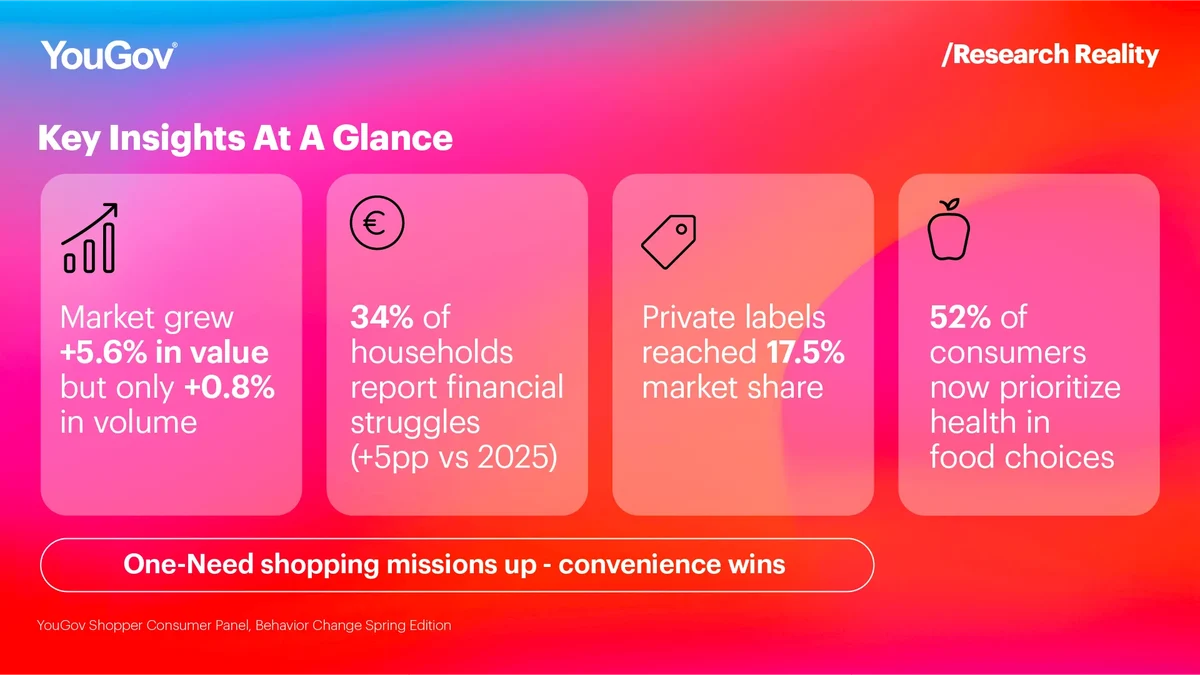
Bulgarian shoppers are spending more per trip but buying smarter. Success requires balancing affordability with quality and health.
The Bulgarian FMCG market continued to expand in the first half of 2026, but growth was driven far more by average price paid than by consumer demand. Consumers remained under financial pressure, prompting more deliberate shopping behavior, stronger focus on promotions, and increasing acceptance of private label products.
At the same time, quality, health, and value for money have become increasingly important purchase drivers. Our analysis, based on YouGov Shopper Consumer Panel and Behavior Change data, reveals a market that is growing, but with shoppers constantly seeking the optimal balance between affordability and quality.
FMCG Growth Continue But It's All About Spending, Not Volume
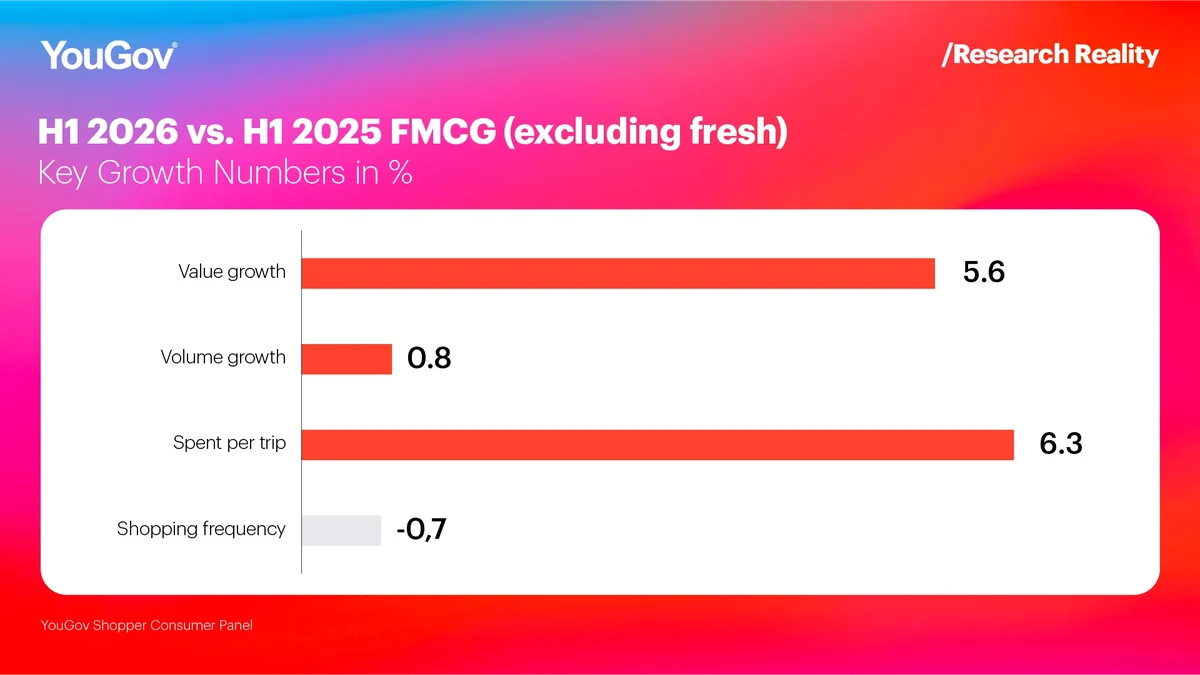
In H1 2026, Total FMCG excluding Fresh recorded value growth of +5.6%, while volume increased by only +0.8%.
The key driver behind market expansion was a +6.3% increase in spending per shopping trip, supported by average price growth of +4.7%. Meanwhile, shopping frequency declined by -0.7%, indicating that consumers visited stores less often but spent more during each trip.
Rather than increasing consumption, households are concentrating purchases into fewer, larger baskets and managing budgets more carefully. Brands should focus on maximizing value per transaction rather than relying on frequency increases.
Why 62% of Your Shoppers Are Worried About Money
Economic concerns intensified during 2026. One-third of Bulgarian households report struggling financially, with the share of financially constrained consumers rising to 34%, up nearly 5 percentage points versus spring 2025.
At the same time, 62% of consumers identify economic and budget concerns among their top worries—a six-point increase year-on-year.
3 Ways Financial Pressure Is Reshaping Shopping Behavior:
- 59% actively check prices before purchasing (+3pp)
- 52% try to keep total basket spending low (+5pp)
- 52% search for or wait for promotions (+3pp)
The result? A shopper who is becoming increasingly strategic and disciplined, focusing less on impulse buying and more on planned, value-driven purchases.
Consumers are planning purchases more carefully. Brands that communicate clear value propositions and align with promotional calendars will capture more planned purchases.
Trading Down Is Now Mainstream And It's Not Just About Price
One of the most significant market developments in H1 2026 is the continued growth of trading-down behavior.
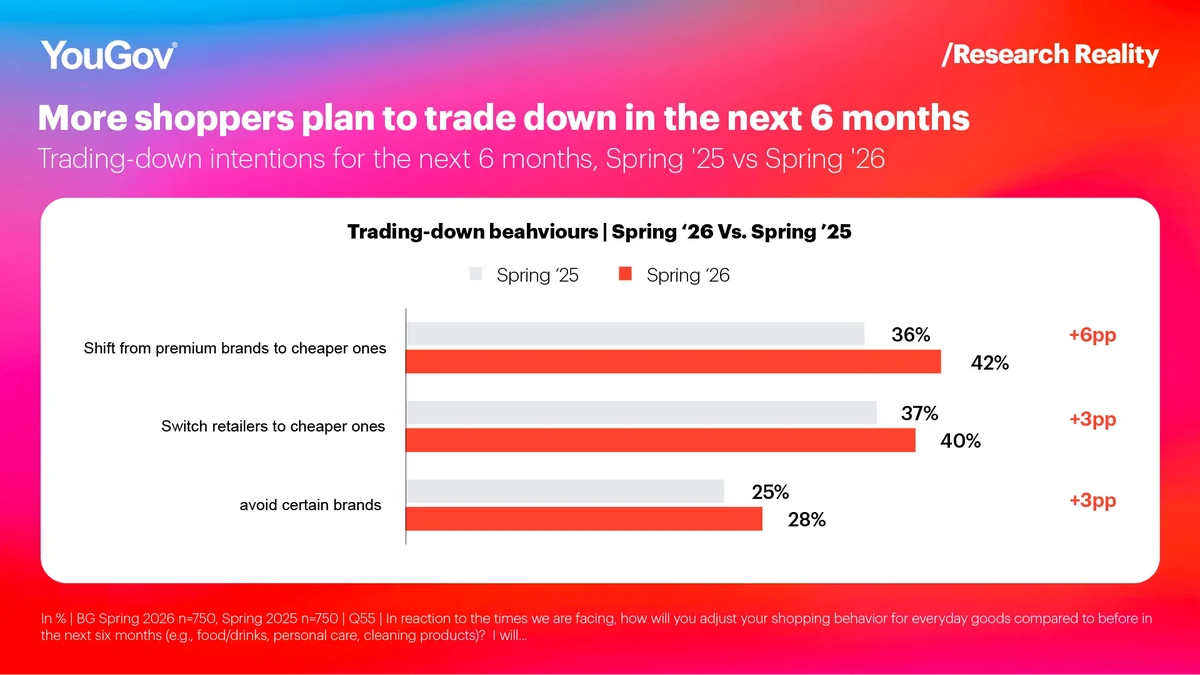
But here's the critical shift: trading down is no longer solely about affordability. Consumers increasingly perceive private labels as offering comparable quality to branded products.
"56% of Bulgarians prefer private label products, while 64% are unwilling to pay extra simply for a brand name"
This marks an important shift in consumer mindset: private labels are increasingly viewed not as a compromise but as a smart purchasing choice.
Private Labels Hit 17.5%: The 3 Drivers Behind Growth
Private label penetration continued to strengthen across FMCG. The share of private labels in FMCG value sales increased from 16.5% to 17.5% between H1 2025 and H1 2026.
Three factors driving this trend:
- Persistent household budget pressure: 34% of households struggling financially
- Increased price comparison behavior: 59% actively checking prices
- Declining quality stigma: 56% now prefer private labels
How Brands Can Fight Back
However, brands still maintain important advantages. More than half of consumers (52%) believe brands are better at innovation, suggesting that innovation remains one of the strongest defenses against private label encroachment.
Brands must invest in meaningful innovation: functional benefits, sustainability credentials, and health attributes that private labels cannot easily replicate.
Promotions Account for 41.5% of FMCG Value And Growing
Promotional activity continues to play a major role in FMCG purchasing decisions. Promotional sales accounted for 41.5% of FMCG value in H1 2026, slightly higher than the 40.9% recorded a year earlier.
The growing reliance on promotions reinforces the broader consumer trend of value-seeking behavior. Consumers increasingly delay purchases or switch products to take advantage of deals, making pricing and promotional strategies more influential than ever.
Smaller Baskets Are Winning: One-Need Missions Surge
Consumer budgets are changing how people shop. The market is seeing growth in smaller shopping missions, while larger stock-up trips are becoming less important.
In total FMCG (excluding fresh):
- One-Need trips (: 1-3 categories with promotion-share <=50%) increased from 25.0% to 25.5% of all trips
- Stock-Up (4-11 categories, fresh share <=40%) and large stock-up missions (12+ categories) softened slightly.
Value growth is increasingly generated through convenience-oriented missions. One-Need baskets delivered +10% value growth, outperforming several larger mission types.
One-Need missions delivered +10% value growth - the highest among all basket types. Brands optimized for convenience and smaller pack sizes are winning share.This signals a shift toward more immediate, need-based shopping rather than large periodic pantry-loading trips. Product formats, pack sizes and retail placement strategies must adapt to this new reality.
Health Benefits are must for food and drink categories
While budgets remain the primary constraint, health has become one of the strongest long-term influences on purchasing behavior.
The Top 4 Shopping Drivers Among Bulgarian Consumers:
- 50% identify product quality as a key shopping driver
- 48% cite promotions
- 43% prioritize budget-friendly choices
- 33% mention health and wellness
When specifically considering food and drink choices, 52% of Bulgarians say they are trying to act or buy more healthily when choosing a drink - significantly above the European average of 45%. Home cleaning and laudry are led by time saving and less effort, while health benefits are recognized at early stage.
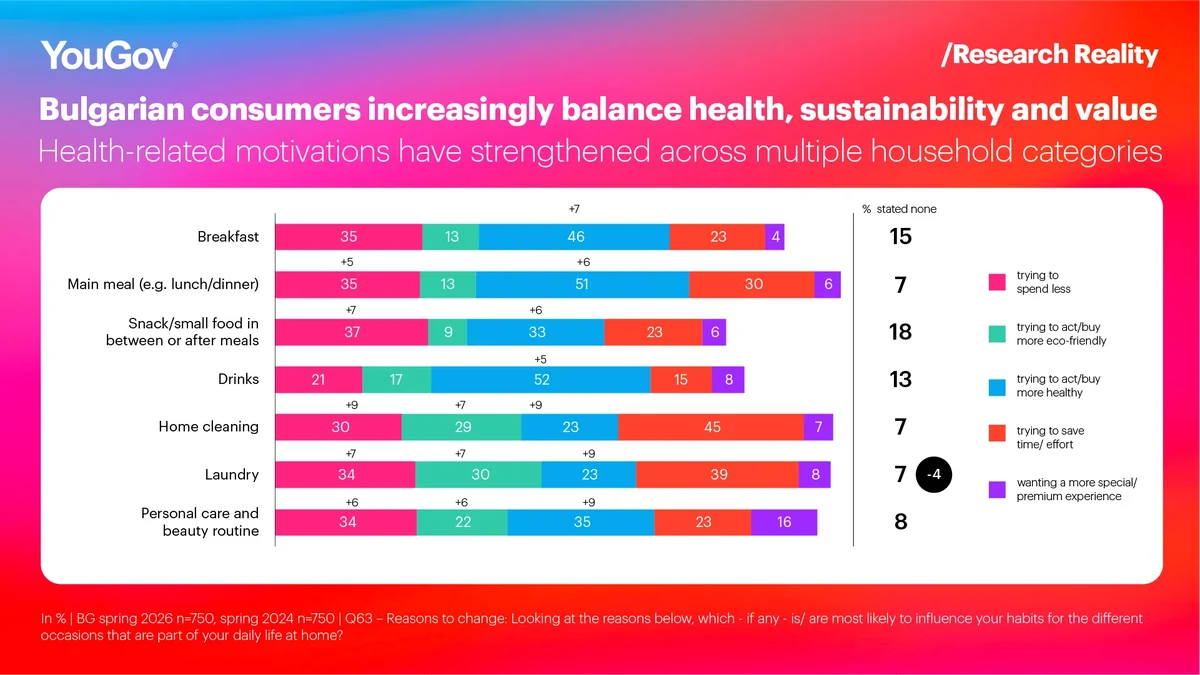
5 Health Trends Consumers Are Prioritizing when it comes to food and drinks:
1. Sugar reduction
2. Functional benefits (gut health, immunity, energy)
3. Gut health specifically
4. Natural ingredients
5. Transparent product information
The health trend is evolving from a niche interest into an early majority expectation. Brands that authentically address health concerns with transparent communication will gain competitive advantage.
Trust, Quality and Value Trump Marketing Hype
Our data shows that Bulgarian consumers are becoming more pragmatic. The strongest purchase drivers are:
• Value for money
• Product safety
• Fair pricing
• Quality
• Clear health benefits
Consumers place less importance on trend-driven claims, influencer endorsements or marketing buzzwords. Instead, trust is built through tangible product benefits, natural ingredients, local origin and transparent communication.
Three Key Takeaways:
1. Growth is value-driven, not volume-driven.
Market expansion is supported by higher spending levels and price inflation, while consumption growth remains modest.Focus on maximizing value per transaction.
2. Smart shopping is the new normal.
Consumers check prices more often, rely on promotions, and embrace private labels without sacrificing quality expectations. Your value proposition must be crystal clear.
3. Affordability alone won't win.
While budget matters, shoppers also seek quality, health benefits, and trust. Brands that successfully combine competitive pricing with genuine functional benefits and transparent communication will thrive.
Want deeper insights? Contact miroslava.georgieva@yougov.com for category-specific analysis and strategic recommendations based on YouGov Shopper data. We can help you understand exactly where your brand or category stands and what actions will drive growth in this evolving market.
Methodology: YouGov Shopper Bulgara is based on continuously collected data and rolling surveys on 2500 households representative for the total population of the country.
YouGov Shopper offers access to a wealth of expertise and quality consumer panel data. We help the world’s most recognized FMCG & Retail brands to deliver superior customer experiences at every stage of the shopper journey.