



When Promotions Become the Norm
How promotions are reshaping shopper behaviour and brand performance in the Czech Republic and Slovakia
Promotions continue to gain ground
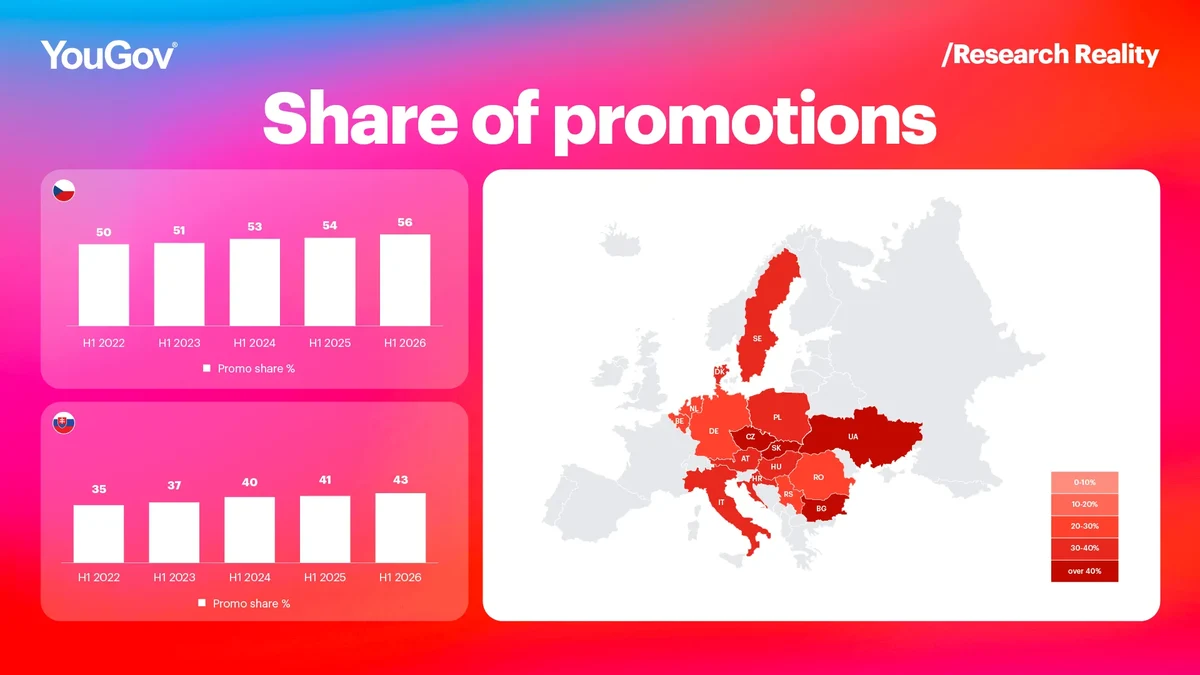
For several years in a row, we have seen a continuous increase in shopper spending directed towards promotional purchases in the Czech Republic and Slovakia. This comes on top of the fact that promotional shares in both markets are already among the highest in Europe.
Promotions are one of the main tools shoppers use to address their economic and budget concerns, although the circumstances differ between the two markets. While consumer optimism and the outlook for the future are much better in the Czech Republic, Slovakia ranks lowest among its neighboring countries in terms of consumer confidence. Even private labels, usually seen as a more affordable alternative, are now purchased to a greater extent on promotion, further contributing to this trend.
The YouGov Shopper team in the Czech & Slovak Republic has therefore prepared a special study aimed at gaining a deeper understanding of the promotional phenomenon. How have promotions impacted overall shopping behaviour? What impact do they have on brands? How do shoppers perceive promotions after many years of high promotional intensity? Which shopper types have emerged, and what motivates shoppers in general?
When the whole basket is on promotion
Given the growing importance of promotions, we are also seeing an increasing number of shopping trips where shoppers purchase only promoted items. In Slovakia, every tenth shopping basket contains only products purchased on promotion, while in the Czech Republic the figure is above 15%.
This can be attributed to the continuous rise of so-called cherry-picking trips, smaller shopping missions involving purchases from up to three different categories, where the promotional share reaches an incredible level of around 90% in both markets.
The actual use of promotional leaflets when shopping still plays an important role in driving promotional share upwards. However, the use of loyalty cards and apps also has a positive impact on the value spent on promotions.
More promotions do not automatically mean stronger brands
Analyzing 1,000 FMCG brands over the long term in the Czech market, we see that increasing promotional dependency does not clearly translate into higher long-term increases in penetration. In the case of loyalty, measured as coverage of demand, it led to a decrease for the majority of brands.
This can also serve as a valuable lesson for other countries, illustrating what greater promotional dependency can mean for a brand in a highly promotion-driven market such as the Czech Republic.
From a mid-term perspective, after analyzing over 160,000 purchase chains in the Czech Republic and over 100,000 in Slovakia, looking at what was purchased before and after a promotion, we see that promotions are still helping the majority of these shopper journeys to defend the market position of the promoted brand.
However, this varies across categories and brands. It is therefore vital for each brand to understand the extent of this contribution and to learn to what extent promotions help recruit shoppers who will also buy the brand at regular price.
Years of promotions have shaped shopper perceptions
With so many promotions available, shoppers have developed various viewpoints over the years, especially in the Czech Republic. More than 7 out of 10 feel that retailers sometimes increase the regular price so that subsequent discounts appear more attractive.
Almost half see regular, non-promotional prices as unrealistic and declare that the only way to shop for groceries nowadays is on promotion. The situation also puts pressure on retailers, as more than one quarter of shoppers in both countries do not trust retailers to offer genuinely good promotions.
Not every promotion-driven shopper behaves the same way
Czech and Slovak shoppers have also evolved in terms of the role promotions play in their decision-making process.
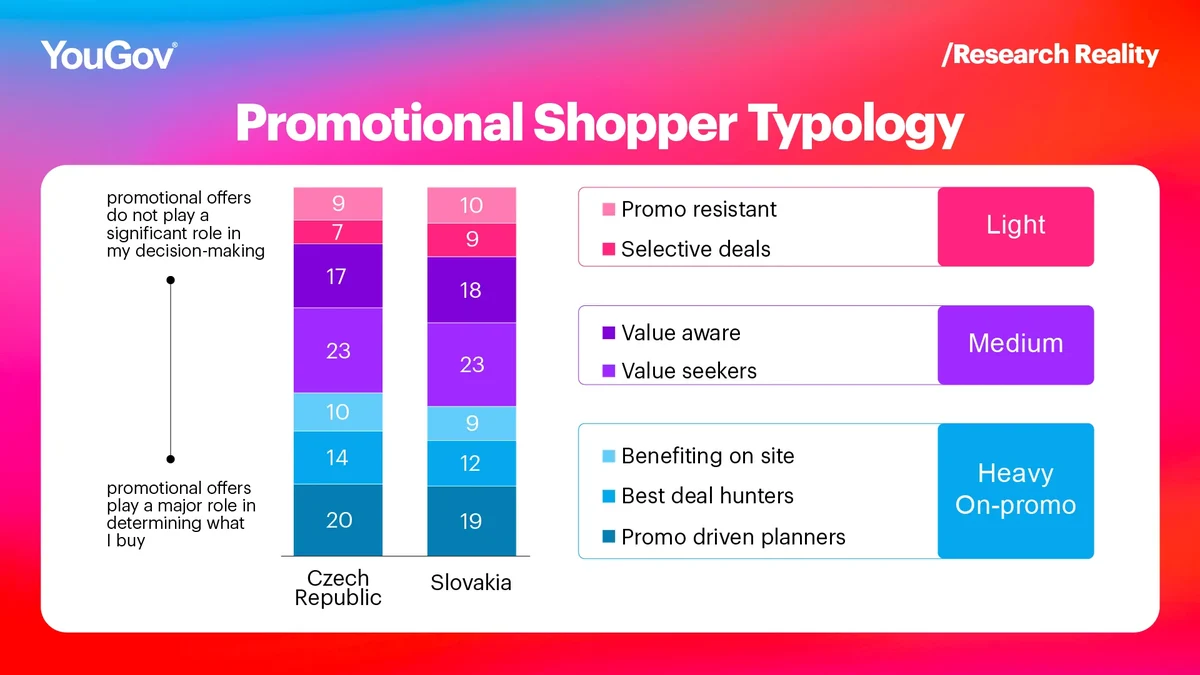
We distinguish the so-called Heavy OnPromo shoppers, who are already responsible for a significant share of total FMCG shopping expenditure: 45% in the Czech Republic and 41% in Slovakia.
But one definition does not fit all when it comes to their approach to promotions. Some are promo-driven planners who intensively use various inputs and touchpoints. Some are best-deal hunters willing to shop across multiple stores to get the best deal, while others are heavy promotional buyers who benefit from offers on-site, in the store where they usually shop.
The biggest group in both countries is still the so-called Value Seekers, accounting for 23% of all shoppers. They belong to the Medium OnPromo segment and mainly look for special offers within a selected assortment.
Only around one in ten shoppers in both countries is a so-called Promo Resistant shopper. These shoppers primarily buy what they need and do not actively look for special offers. They make decisions at the point of sale and tend to concentrate their purchases in one or a few stores.
Whether you are a retailer or a brand, it is now fundamental to understand how these various shopper types are represented within your shopper base and among your category shoppers, and what percentage of volume and value they account for. This understanding can help you align and optimize your approach to promotions.
Want to know more?
Are you curious to know more about promotions, including which promotional mechanisms motivate shoppers the most in the Czech Republic and Slovakia?
Get in touch with us and ask for access to the OnPromo multiclient study.
Methodology:
YouGov Shopper Czech Republic is built on continuously collected data from 4,000 households and Slovakia is built on 3,000 households, representing the country’s total population.
YouGov Shopper offers access to a wealth of expertise and quality consumer panel data. We help the world’s most recognized FMCG & Retail brands to deliver superior customer experiences at every stage of the shopper journey. Learn more about YouGov Shopper.