
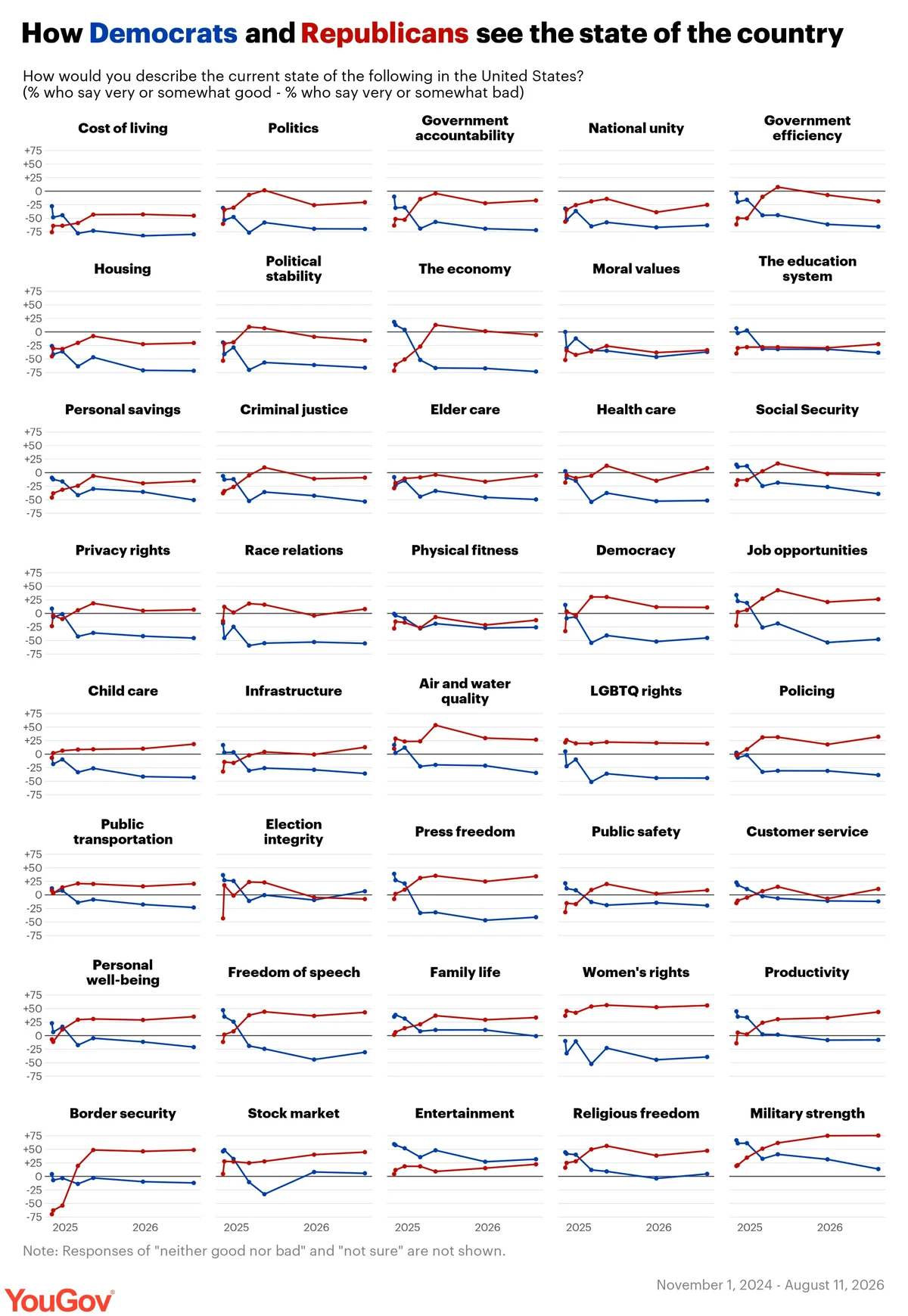
Americans continue to be more negative than positive about the state of the country across most of 40 dimensions YouGov tracks, including the cost of living, political stability, moral values, and race relations. Since Donald Trump's inauguration in 2025, Democrats have grown more negative about almost everything, while Republicans have grown far more positive. Overall, Americans have become more negative about most things — with border security a big exception.
We asked Americans to evaluate the current state of 40 aspects of life in the U.S. seven times between November 1, 2024 and August 13, 2026. Each area of life was rated by respondents as very good, somewhat good, neither good nor bad, somewhat bad, or very bad. The results are presented in this article as net ratings: the share saying each one is very or somewhat good minus the share saying it is very or somewhat bad.
In the most recent survey, 31 of the 40 areas of life have a negative net rating, meaning more Americans say the areas are currently bad than good. Cost of living has the lowest net rating (-66) by a wide margin, as it has in every wave since we began tracking. Behind it are a variety of political arenas: politics (-53), government accountability (-50), national unity (-49), government efficiency (-48), and political stability (-45).
Only nine dimensions have positive net ratings. Military strength is the best-rated area in the tracker, at +36, followed by religious freedom (+23), entertainment (+21), and the stock market (+19).
Net ratings of border security have improved the most since the first survey was conducted in November 2024, just before the election — to +10 from -35, an increase of 46 percentage points. The only other dimension that has improved even slightly is public safety, to -8 from -9 in 2024 (a change well within the margin of error).
All of the 38 other areas have experienced a decline. Across all areas, there has been an average decline of 7 points since November 2024. Net ratings of LGBTQ rights, job opportunities, Social Security, air and water quality, press freedom, and health care each have fallen by at least 15 points since 2024.
On many measures, Republicans became much more positive about the state of the country after Trump returned to office, while Democrats became significantly more negative.
In the survey conducted in the days leading up to the presidential election, 25 of the 40 items had positive net ratings among Democrats, compared to only nine among Republicans. Across all 40 areas, the average net rating was +11 among Democrats and -24 among Republicans. By February 28 - March 4, 2025 — six weeks into Trump's second term — Democrats and Republicans had reversed: Democrats averaged -32 across the 40 items and Republicans averaged +8. In the most recent survey, conducted August 11 - 13, 2026, Democrats average -36 and Republicans average +10.
Republicans' net rating of border security was -70 before the 2024 election and it is now +49, a 119-point change. On the economy they have moved to -6 from -72, on freedom of speech to +43 from -12, and on press freedom to +34 from -8. Democrats moved the opposite way on many areas of life: on the economy to -73 from +18, press freedom to -41 from +39, freedom of speech to -31 from +47, and border security to -12 from +4.
But Republicans' ratings of the country have not improved linearly during Trump's second term. Of the 40 areas of life rated in the surveys, 23 hit their Republican high point in the May 9 - 12, 2025 survey, and since then Republicans' average net rating across all items has fallen to +10 from +17. Government efficiency fell from +8 to -19 among Republicans over that period, political stability to -16 from +7, politics to -21 from +2, and election integrity to -8 from +23.
Net ratings among Democrats have generally continued falling. Of the 40 areas, 20 are at their lowest net rating among Democrats, including the economy (-73), government accountability (-72), housing (-72), personal savings (-51), Social Security (-39), and air and water quality (-35). Only five of the 40 areas now receive positive net ratings from Democrats: entertainment (+32), military strength (+14), election integrity (+7), the stock market (+6) and religious freedom (+5).
Fifteen of the 40 items have negative net ratings among members of both parties, including cost of living (-80 among Democrats and -45 among Republicans), housing (-72 and -20), personal savings (-51 and -15), elder care (-49 and -6), criminal justice (-53 and -9), the education system (-39 and -22), and the economy (-73 and -6). Only four items have positive net ratings among both parties: military strength (+14 and +75), religious freedom (+5 and +47), entertainment (+32 and +22), and the stock market (+6 and +45).
The narrowest partisan gap is on moral values, with Democrats' net rating of moral values in the country at -37 and Republicans at -34.
Related:
— Carl Bialik contributed to this article
See the results for these YouGov polls:
- August 11 - 13, 2026
- December 22 - 28, 2025
- May 9 - 12, 2025
- February 28 - March 4, 2025
- December 19 - 23, 2024
- November 7 - 10, 2024
- November 1 - 5, 2024
Methodology: This YouGov poll was conducted online on August 11 - 13, 2026 among 1,097 U.S. adult citizens. A random sample (stratified by gender, age, race, education, geographic region, and voter registration) was selected from the 2019 American Community Survey. The sample was weighted according to gender, age, race, education, 2024 presidential vote, 2020 election turnout and presidential vote, baseline party identification, and current voter registration status. 2024 presidential vote, at time of weighting, was estimated to be 48% Harris and 50% Trump. Demographic weighting targets come from the 2019 American Community Survey. Baseline party identification is the respondent’s most recent answer given around November 8, 2024, and is weighted to the estimated distribution at that time (31% Democratic, 33% Republican). The margin of error for the overall sample is approximately 4 percentage points.
Image: Getty (Samuel Corum)
What do you really think about President Trump, American politics in general, and everything else? Share your reality, join the YouGov panel, and get paid to share your thoughts. Sign up here.