
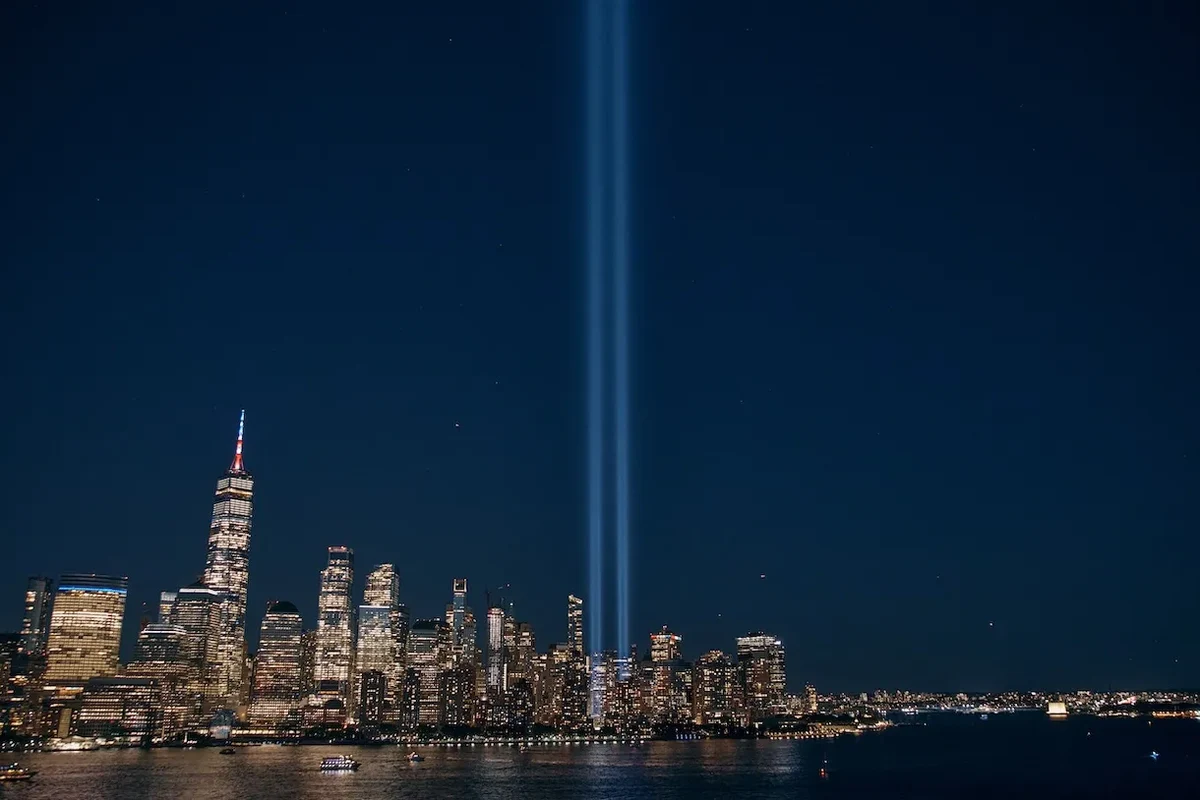
Twenty-five years after September 11, 2001, the vast majority of Americans say the attacks on the World Trade Center and the Pentagon changed the country, according to the latest Economist / YouGov Poll. What has changed is which groups of Americans worry about terrorism. On multiple measures, Republicans have grown less alarmed about terrorism, while the change among Democrats' views has been smaller and sometimes in the opposite direction.
Two-thirds of Americans say terrorism is an immediate and serious threat (21%) or a somewhat serious threat (45%) to the U.S.; 21% say it is a minor threat and 3% say it is no threat at all. Today, Democrats and Republicans are about equally likely to view terrorism as an immediate and serious threat (22% vs. 25%), but that has not always been the case. Just before Donald Trump's inauguration in January 2025, Republicans were about twice as likely as Democrats to believe terrorism posed an immediate and serious threat: 59% did compared to only 29% of Democrats.
About half (49%) of Americans — including similar shares of Democrats (48%) and Republicans (51%) — believe a terrorist attack against the U.S. in the next 12 months is very or somewhat likely. In September 2021, when the question was last asked, Democrats were 33 percentage points less likely than Republicans to say an attack was likely in the next 12 months (48% vs. 81%).
36% of Americans say the U.S. government should be doing more to fight terrorism, 32% say it is doing enough, and 10% say it is doing too much. Fewer Americans say more should be done to fight terrorism than at any time since the question was first asked in May 2016, and down from 53% saying so in January 2025. Today Republicans are only slightly more likely than Democrats to say more should be done (46% vs. 39%); in January 2025, the gap was far wider (70% vs. 44%).
Roughly half (52%) of Americans say it is closer to their view that the U.S. will be safer from terrorism in the long run if it stays out of other countries' affairs, while 48% say the U.S. will be safer if it confronts the countries and groups that promote terrorism. Democrats are more likely to say staying out of other countries' affairs will make the U.S. safer (70% vs. 30% who say confronting them will), while the reverse is true for Republicans (28% say staying out will make us safer vs. 72% who say confronting will). Overall views on this topic have changed little since it was first asked 16 years ago, but the parties have pulled apart. Democratic support for confronting is at its lowest point since the question was first asked, and the 42-point partisan gap is wider than it has ever been.
44% of Americans say we are much or somewhat safer from terrorist attacks now than we were in 2001, 25% say about the same, and 21% say we are less safe. Far more Americans now say we are safer than in September 2022, the last time the Economist / YouGov Poll asked, when 31% said safer, and it is the highest share since January 2014. The change is almost entirely among Republicans, 55% of whom now say the U.S. is safer, up from 19% four years ago; Democrats are unchanged at 44%.
The survey asked Americans whether it was a mistake to send troops to fight in each of seven wars — World War I, World War II, Korea, Vietnam, Afghanistan, Iraq, and Iran. The highest share says sending troops to Vietnam was a mistake (54%), followed by Iran (49%), Iraq (48%), and Afghanistan (43%); fewer say this about Korea (28%), World War I (14%), and World War II (11%).
Democrats and Republicans differ most in their opinion as to whether sending troops to Iran was a mistake: 74% of Democrats say it was a mistake, compared with 21% of Republicans. Since June 2024, Democrats have grown more likely to call every other war a mistake, and Republicans less so. About Afghanistan, the share of Democrats viewing it as a mistake increased to 59% from 47%, while Republicans seeing it as a mistake fell to 27% from 37%.
Image: Getty (Andres Kudacki / Stringer)
What do you really think about President Trump, American politics in general, and everything else? Share your reality, join the YouGov panel, and get paid to share your thoughts. Sign up here.