The state of Britain’s rivers has been a cause for concern for years, with many now failing to reach good ecological status. Campaigners have typically put the blame on the discharge of sewage, and industrial and agricultural waste.
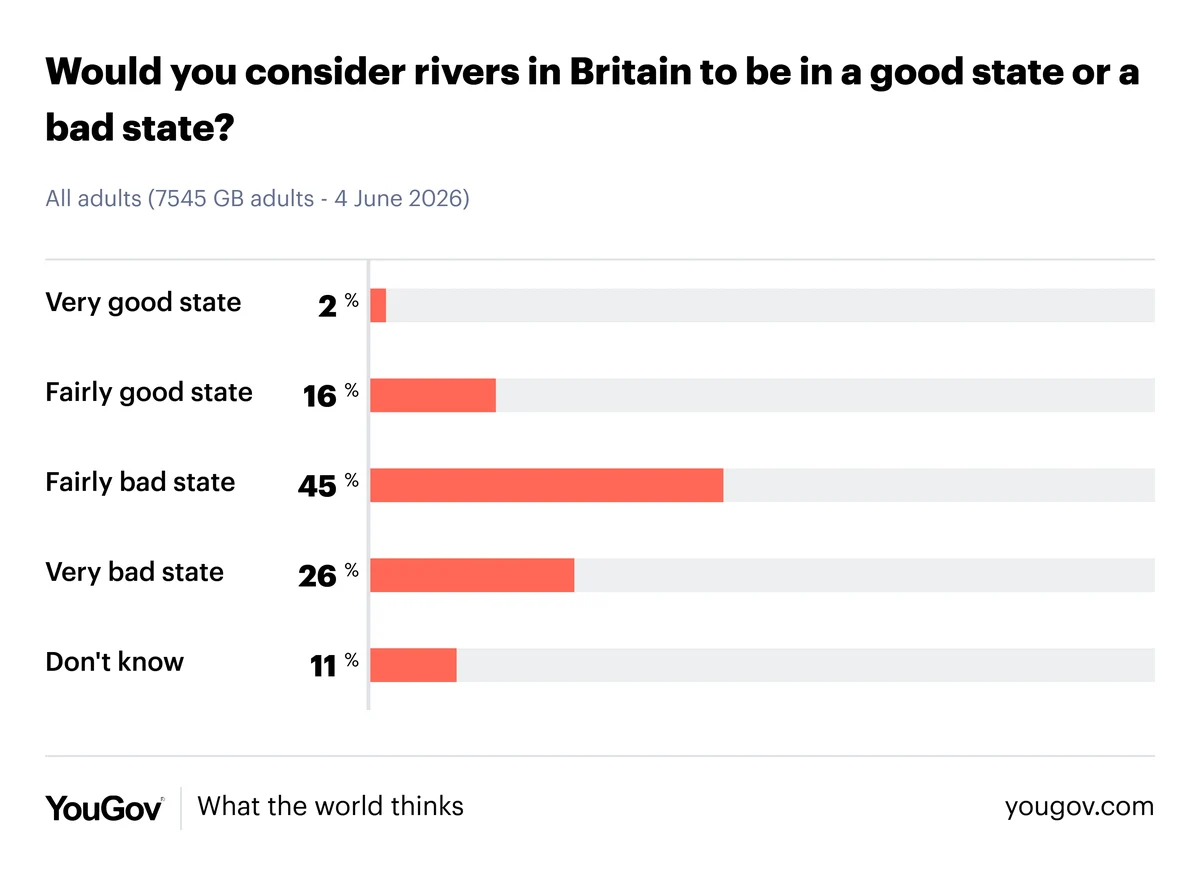
Fully 71% of Britons believe that the country’s rivers are in a bad state, compared to just 18% who feel they’re in a good way.
It’s a concern that unites voters from all parties, with 72-84% of those who backed any of the five main parties at the last election feeling Britain’s rivers are in a poor state. Londoners are the most likely to take the opposing the view, but still believe the UK’s rivers are in a bad way by 60% to 28%.
But what do Britons make of protecting natural resources? To find out, we used our new YouGov AI Interviewer tool to ask respondents: “What do you think are the most important natural resources for the government and society to take care of?”
The AI agent then conducted interviews with each respondent, following up on their responses, in order to provide ‘the why’ behind what Britons think. Our qualitative analysis of attitudes, including quotes, can be found below, along with examples of respondent interviews in their entirety.
Wildlife and the balance of nature
Many respondents want rivers, woodland, hedgerows and green land protected for the wildlife that lives there. They describe nature as a connected system, where losing insects, fish or habitats has knock-on effects on plants, food and people.
- “The UK has a biodiversity crisis due to destruction of habitats and pollution, we need to fix that” – Man, 18-24
- “So the animals can be safe and continue to thrive. Don't want any extinct species or animals dying because of humans which is unfair” – Woman, 35-44
- “With insects plants die, without plants herbivores for, without herbivores carnivores die, we all die” – Man, 45-54
- “When walking towpaths beside the river I would see dragon and damsel flies, butterflies etc. Dragon and damsel flies seem to be a rarity these days” – Man, 55+
Sewage, pollution and the water companies
Many respondents point to sewage, chemicals and farm run-off getting into rivers and seas. Much of their anger is aimed at privatised water companies, which they say put profits, dividends and bonuses ahead of investment, and some call for nationalisation or for bosses to face prison.
- “Private water companies pumping sewage into our rivers and rising energy prices due to privatisation” – Man, 18-24
- “Because private water companies have funnelled the profits into the pockets of their executives and shareholders and got themselves into ridiculous amounts of debt. An essential resource such as water should not be run with profit as the main motive.” – Man, 55+
- “I have developed eye and ear infections and stomach upsets after bathing.” – Woman, 55+
- “Eg if a water company pumps sewerage into a river the CEO and executive board should go to prison” – Man, 55+
Water is essential to life
Many respondents name water as the resource that matters most, simply because people, animals and crops cannot survive without it. Some link this to this summer’s drought, hosepipe bans, leaking pipes and a lack of new reservoirs.
- “everyone uses it daily for hygiene and hydration and its important to have clean water too” – Woman, 18-24
- “Water in its many forms is essential for life. We need to build more reservoirs and quickly” – Man, 55+
- “Without clean water, society dies. This fact was obvious in the past. Water supply (as well as food production) will become an extremely important issue as the climate heats up. Without clean water we die.” – Man, 55+
- “I lived in Scotland for over 20 years and never had a hose pipe ban.” – Woman, 45-54
Green spaces for wellbeing and enjoyment
Some respondents value the countryside, parks, rivers and beaches as places to walk, swim and relax. They talk about the benefits for mental health and the fact that these spaces are free for everyone to use.
- “I often go for walks in a nature reserve near me with lunch if I am having a rough few days or weeks” – Man, 18-24
- “Life is not always easy and having access to open spaces such as parks, riverbanks and the countryside is good for mental health” – Woman, 55+
- “These spaces are freely available to everyone and can be enjoyed without a huge financial cost. They are good for supporting mental health.” – Woman, 55+
- “They break up the endless grey, they provide an area where people can relax, can provide an area for wildlife also” – Man, 45-54
Climate change, heat and clean air
Some respondents frame their choices around climate change, citing this summer’s heatwaves, wildfires and drought. Others focus on air quality and its effect on health, and on trees and forests as a way to absorb carbon.
- “keeping trees growing is key to helping combat climate change and reduce co2 emissions” – Man, 18-24
- “The impact on society is huge, e.g. impact on NHS during recent heatwaves; children and the elderly not being able to keep cool or hydrated” – Woman, 55+
- “The struggle of trying to just keep cool in our own London flat, seeing the news of fires, seeing the plants and parks dried up and watching the animals in our local park suffer” – Woman, 45-54
- “Children dying of asthma caused by air pollution” – Woman, 45-54
Self-sufficiency in food and energy
Some respondents see farmland, North Sea oil and gas, or home-grown renewable power as resources to protect so that Britain relies less on imports. They mention wars, shipping routes and price rises as reasons the country needs to be able to feed and power itself.
- “not relying on other countries for energy. allows us to not be so affected by conflicts and gives us more leverage (or reduces other countries')” – Man, 18-24
- “I think when a country can't feed itself it is in a very vulnerable place both economically and security” – Man, 25-34
- “Other countries could keep increasing their prices or even decide to cut us off” – Woman, 55+
- “The UK needs to be self sufficient in feeding the UK” – Woman, 55+
Protecting land from development
Some respondents want green belt, farmland and woodland kept free from new housing estates, warehouses and solar farms. They argue that once countryside is built on it cannot be replaced, and that brownfield sites and empty buildings should be used first.
- “I think we need to focus on revamping our current infrastructure instead of expanding into these natural spaces. We already have lots of cities and lots of urban areas that are either abandoned or just not built up.” – Man, 18-24
- “Brownfield sites have already had the nature removed. Greenfield sites are too easy and cheap to destroy. I love the countryside but see too many new housing estates taking it over.” – Man, 35-44
- “countryside land cannot be replaced once it is built on & the government dont seem to care” – Man, 35-44
- “Nature has its own food chain and if we start destroying that, we destroy everything that relies on it. Turning green fields into solar farms is a fine example as we cannot eat solar panels!!” – Woman, 55+
Other themes
Smaller points included people themselves as the country’s most important resource, litter and fly-tipping, coastal erosion and flooding, scepticism that the government will act, and the land and water used by data centres.
- “If you don't look after people, you dont have much of anything left.” – Man, 35-44
- “Too many cases of it happening and it's not fair that the person who's property is used has to pay to get the rubbish removed.” – Woman, 55+
- “I live on the coast. There are areas nearby that are literally falling into the sea” – Man, 55+
- “They don’t do it though. They are reactive not proactive” – Woman, 45-54