While Britons might see the Lib Dems as moderate, they also feel they are weak and unclear what the party stands for
Key takeaways
- Support for the Lib Dems has remained largely consistent over the last year, as have Ed Davey’s personal ratings
- When Britons are asked to describe Ed Davey in their own words, 42% answer either “don’t know” or “who?”, with 25% giving at least one positive term and 35% at least one negative term
- “Fun”, “caring” and “friendly” are among the most common positive terms to describe Davey, while “clown”, “weak” and “boring” are among the top negative descriptors
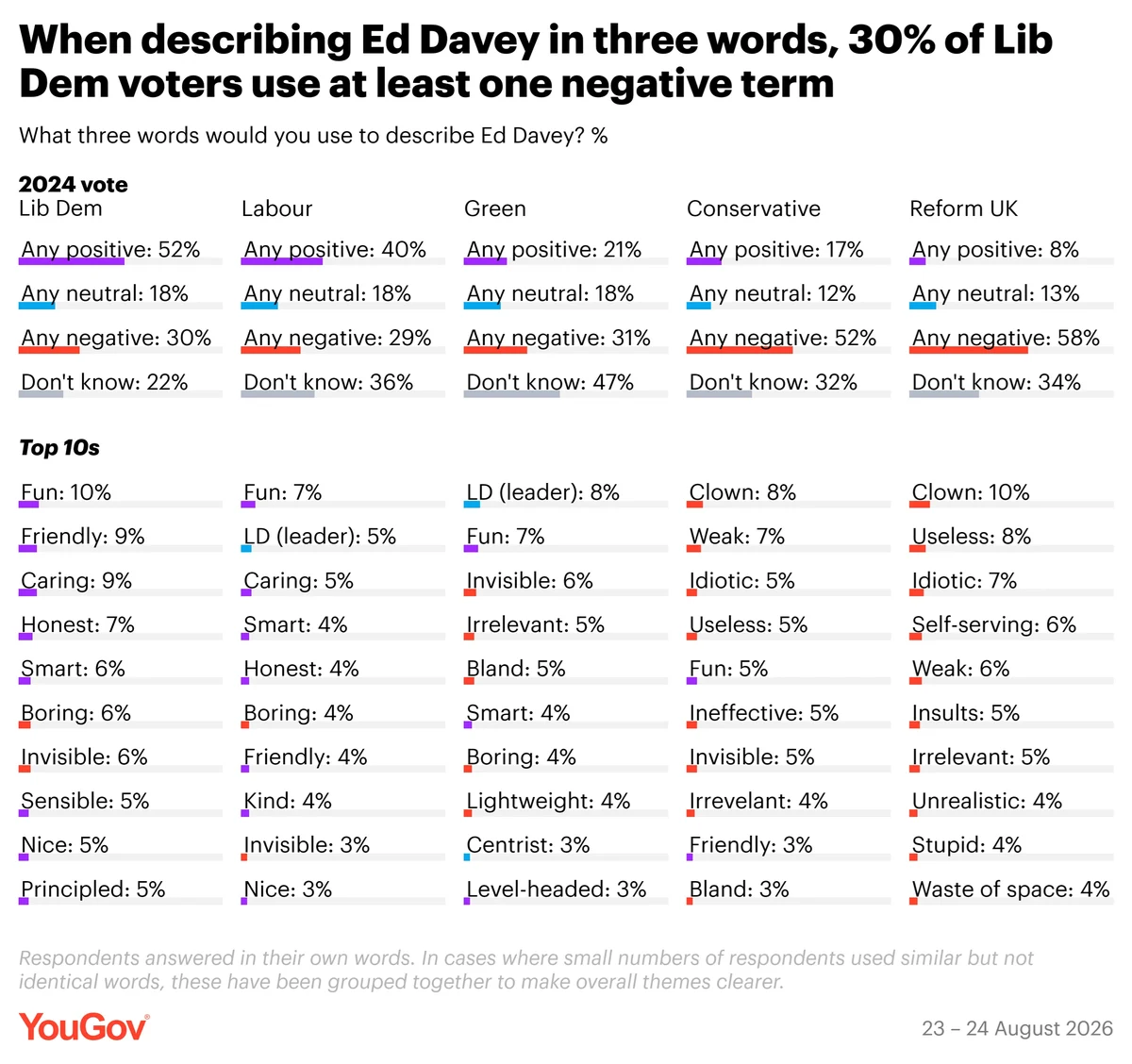
- Just 52% of 2024 Lib Dem voters use a positive term in a three-word description of Ed Davey, with 30% using at least one negative term
- Britons tend to see the Lib Dems as moderate and tolerant, but also weak and unclear what they stand for, with 29-33% of 2024 Lib Dem voters sharing the latter views
Lib Dems from across the country will be heading to Brighton this weekend for the party’s annual conference. Many members will be taking the opportunity to further celebrate the party’s eighth consecutive set of gains in council elections, but others will be looking to express their dissatisfaction at the party’s perceived failure to make much of an impact on the national stage.
A central part of this dissatisfaction is that, while the Lib Dems might be the least unfavourably viewed of the five major parties, they have trailed the rest of the pack in voting intention polls for most of the last year and have seen no real growth in support since the last general election.
Indeed, if anything, the party has fallen back slightly in recent months, with the proportion of Britons giving the Lib Dems as their main voting intention gradually trending downwards since May (from 10% to 8%), as some previous Labour to Lib Dem switchers have returned to Labour. Nonetheless, the proportion willing to consider voting for the party has remained steady, consistently averaging at around a quarter of Britons (24-26%).
Notably, the ratio of these two figures is much lower for the Lib Dems than for other parties, indicating a greater difficulty converting those open to the party into becoming fully fledged voters. The share of Britons giving the Lib Dems as their main voting intention amounts to 34% of those considering the party, relative to 46% for the Greens, 51% for the Conservatives, 57% for Labour and 67% for Reform UK.
What do Britons think of Ed Davey?
Stability is also the watchword when it comes to the personal ratings of party leader Ed Davey. In contrast to the rise in Kemi Badenoch’s favourability figures and the fall in Nigel Farage’s over the last year, Davey’s latest net favourability rating of -8 is near identical to his score of -6 last September, with only small variation in the interim (a low of -14 and a high of -3).
Perceptions of whether Davey is doing well as leader of the Lib Dems offer a similar picture. A year ago, the public were evenly split 29% to 29% on the question; today, they are divided 28% to 31%, though this is a small improvement since March, when Davey was seen to be doing badly by 36% to 26%.
Instead, perhaps the most notable feature of Davey’s personal ratings are the comparatively high don’t know rates (36-41%), which are now greater than those for any of the other four major party leaders.
How would Britons describe Ed Davey?
This lack of awareness is apparent when asking Britons to describe Ed Davey in three words, with 28% saying they don’t know or are unsure how do that, while a further 14% more directly query “who?”. As can be seen in the chart below, these phrases dwarf any other descriptions, positive or negative.
Nonetheless, a quarter of Britons (25%) use at least one positive term to describe the Lib Dem leader, with these tending to paint a jovial and well-meaning picture: 5% characterise him as fun or amusing, while allusions to Davey being kind, caring, friendly or decent are each made by 2-3% of the public. Some stress a more serious figure, with references to him being smart, sensible or realistic also each cropping up in 2-3% of descriptions.
Not all see the funny side of Davey’s stunts: more than a third of Britons (35%) use at least one negative term in their three-word description, with recurring themes being that he’s a clown (used by 4%) or idiotic (2%), that he’s boring (4%) or bland (3%), and that he’s invisible (3%) or irrelevant (3%).
One in seven Britons (15%) feature one or more neutral terms in their summary of Davey, with the most common simply being job descriptions: 3% of the public note that he is the Lib Dem leader and another 3% even more vaguely identify him as a politician or MP.
Even among just Lib Dem voters, the descriptions are something of a mixed bag. Only around half of those who backed the party in 2024 (52%) use at least one positive term when describing Davey, while as many as 30% use at least one negative term. That he is too boring or too invisible are the most common criticisms here, both being levelled by 6%.
Nonetheless, positive depictions of Davey are the norm among Lib Dem voters, with 10% bringing up his fun nature in their three-word descriptions, while references to him being friendly or caring are both made by 9%, and that he is honest or smart by 6-7%.
Labour voters offer fairly similar descriptions of Davey, though with a greater 36% being unsure how they feel about the Lib Dem leader, something true of nearly half of Green voters (47%), just 21% of whom offer at least one positive term in their rough sketch.
Majorities of Reform (58%) and Conservative voters (52%) use at least one negative term to describe Davey, with references to him being a clown, idiotic, weak or useless among the most common for both groups.
What do Britons think about the Lib Dems?
The image of the wider Lib Dems is likewise a bit of a patchwork of positives and negatives. In the pluses column, Britons see the party as moderate rather than extreme by a margin of 50% to 7%, while also being more likely to view them as tolerant (37%) than prejudiced (14%).
On the other hand, a majority of the public (52%) describe the Lib Dems as weak, with Britons also tending to feel that it’s unclear what the party stands for (by 43% to 18%), that they’re out of touch (by 39% to 17%) and that they’re incompetent (by 32% to 25%).
Britons are split 26% to 29% over whether or not Ed Davey’s party is trustworthy, while being similarly divided over whether the Lib Dems care about ordinary people (30% vs 29%) or are trying to do the right thing (30% vs 32%).
As with Davey himself, a clear degree of dissatisfaction with the state of the party is evident among Lib Dem voters, who are more likely to describe the party as weak (33%) than strong (20%), with 29% also saying it’s unclear what the Lib Dems stand for, even if a larger minority (44%) feel the party has a clear sense of purpose.
These concerns are also common among Labour voters, who despite typically having a favourable view of the Lib Dems tend to see them as weak (by 45% to 9%) and lacking a clear purpose (38% vs 26%), while also being divided over whether Ed Davey’s party is in or out of touch (28% vs 27%).
Nonetheless, Labour voters also tend to feel the Lib Dems care about ordinary people (by 48% to 17%), are trying to do the right thing (46% vs 19%), are trustworthy (42% vs 18%) and are competent (37% vs 18%), with majorities additionally describing them as tolerant (54%) and moderate (65%).
See the full results here and here
Interested in taking YouGov surveys? What do you think about Ed Davey, the Lib Dems, and everything else? Have your say, join the YouGov panel, and get paid to share your thoughts. Sign up here.
Interested in commissioning YouGov research? We connect in real-time with real people around the world to gather their thoughts, behaviours, and opinions, to ensure that our research data is powered by reality. Explore our survey services here.
Photo: Getty