



Sweden shows muted interest ahead of FIFA World Cup 2026, as engagement splits across demographics. YouGov data reveals selective viewing habits, low overall anticipation, and clear opportunities for targeted brand activation.
As the 2026 FIFA World Cup in Canada, Mexico, and the United States draws closer, anticipation in Sweden remains subdued. According to new YouGov data, only 35 % of Swedes say they are looking forward to the tournament, while more than half express little to no enthusiasm (52 %). The findings point to a fragmented landscape in which the world’s biggest football event fails to capture broad national excitement, instead resonating with specific audience segments.
A divided audience: gender and age define engagement
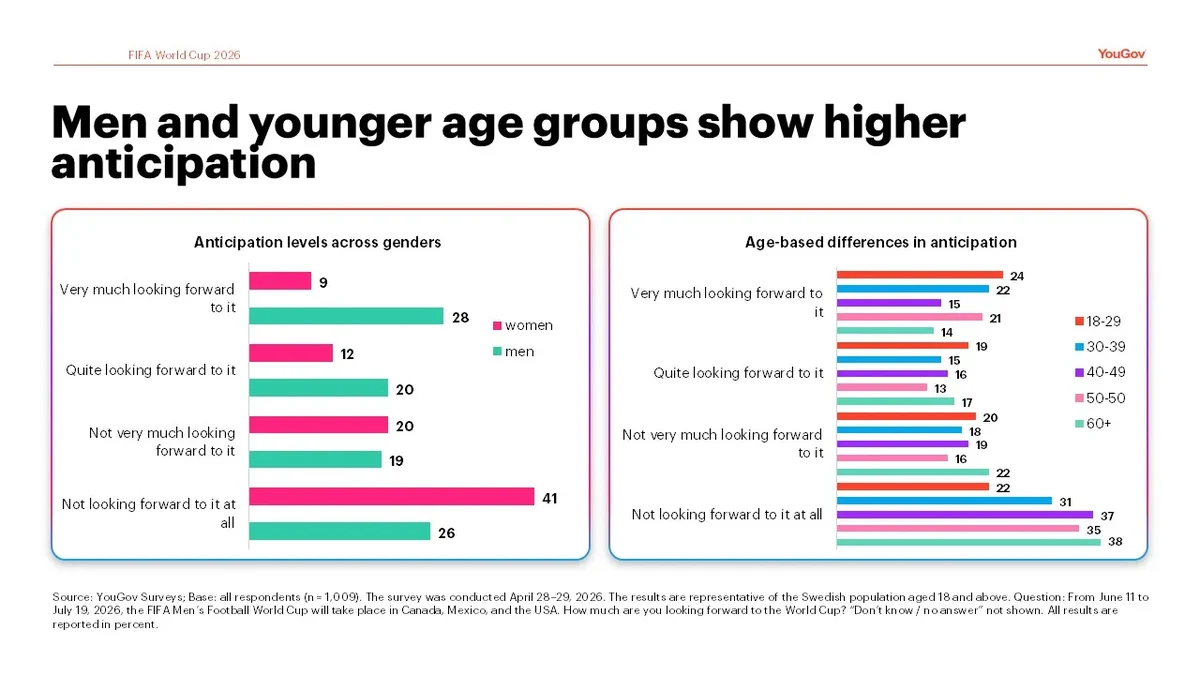
This divide is particularly evident when looking at gender and age. Interest is significantly higher among men, with 48 % saying they are looking forward to the tournament, compared to just 21 % of women. Younger audiences are also more engaged, led by 18–29-year-olds, where 43 % express anticipation. In contrast, older generations remain largely disengaged, with 60 % of those aged 60 and above reporting minimal or no excitement. The data suggests that Sweden’s World Cup audience is not only limited in size but also highly concentrated within distinct demographic groups.
Selective viewing replaces all-in engagement
Among those who do plan to follow the tournament, viewing behaviour is far from comprehensive. Rather than engaging with the full event, Swedish audiences are curating their experience around key moments. Only 8 % of Swedes say they plan to follow every match, while 32 % intend to watch most matches, 23 % focus specifically on Sweden’s games, and 13 % limit themselves to selected matches. This distribution shows that the majority of viewers are approaching the tournament selectively rather than as a continuous viewing experience, reinforcing the idea of fragmented attention.
The home becomes the primary viewing arena
When it comes to where matches are watched, the home clearly dominates. 56 % of viewers plan to watch alone at home, while 45 % expect to watch with friends at home and 31 % at friends’ homes. In contrast, public viewing formats play a secondary role, with only 18 % planning to watch in bars or pubs, 17 % at outdoor screenings, and just 10 % attending large public viewing events. These figures underline that the World Cup in Sweden will largely be experienced in private and small-group settings rather than large communal environments.
Low sponsor awareness highlights branding challenge
Sponsor recognition remains relatively weak in Sweden, with 61 % of respondents unable to name any official World Cup sponsor. Among those who do, Coca-Cola leads with 25 %, followed by adidas at 19 %, McDonald’s at 15 %, Qatar Airways at 11 %, and Budweiser at 8 %. In terms of perceived credibility, adidas ranks highest at 30 %, ahead of Coca-Cola at 28 % and McDonald’s at 17 %. These figures highlight the importance of strong brand equity in achieving visibility within a low-engagement environment.
Disinterest, not external factors, drives non-viewing
Among those who do not plan to watch any matches, the reasons are overwhelmingly consistent. A striking 76 % cite general disinterest in football as the primary reason. By comparison, structural or external factors have minimal impact: only 2 % mention inconvenient match times, while 5 % point to political concerns related to the USA and another 5 % to criticism of FIFA or major sporting events. This clearly shows that lack of engagement is driven by fundamental interest rather than situational barriers.
Limited impact of time zones on behaviour and consumption
Despite matches being played across different time zones, relatively few consumers are willing to adapt their routines. Only 19 % say they would still start work at their usual time despite less sleep, while 7 % would shift their working hours and 5% would take time off or use overtime. Similarly, extended retail opportunities appear limited, with 61 % not interested in longer supermarket opening hours during late matches. However, younger audiences are more receptive, with 53 % of 18–29-year-olds expressing at least some interest, indicating potential niche opportunities.
Targeted strategies key to unlocking value
Overall, the data paints a clear picture: while only 35 % of Swedes show anticipation for the World Cup, this audience is both sizable and clearly defined. With engagement heavily skewed towards younger consumers and men, and with over half of viewers (56 %) watching primarily at home, brands have a distinct opportunity to target audiences precisely. In this context, broad, mass-market activation is unlikely to deliver optimal results Rather, success depends on targeted, context-specific strategies that reflect how, where and with whom the Swedish public engages with the 2026 FIFA World Cup.
Methodology
Data for this study were collected via online interviews conducted using YouGov Surveys among members of the YouGov Panel who had previously agreed to participate. A total of 1,009 respondents were interviewed between April 28 and April 29, 2026.
The sample was quota-sampled by age, gender, and region and subsequently weighted to be representative of the adult population (aged 18 and over) living in Sweden.