

Attitudes towards migrants from various countries have shifted, with Poles in particular now seen more warmly
Key takeaways
- 69% of Britons say immigration over the last 10 years has been too high; in 2016 when we asked the same question 70% said so
- Britons now most likely to say migration has been mostly bad for the UK (43%), a 10pt increase from 2016, and compared to 21% who say it has been mostly good and 29% ‘both good and bad’
- Britons now more likely to want fewer or no migrants from Russia, Israel, India and the USA than in 2016
- Attitudes towards migrants from Poland have improved substantially since 2016, with most Britons (53%) now either happy with current numbers or wanting more to come
- Criminal history, skills in areas with shortages, and English proficiency are the most important factors Britons say should be taken into account when deciding whether to let an economic migrant come to the UK
- Voters differ most on a migrant’s religion, which 67% of Reform voters see as important but only 12% of Green voters
In August of 2016, a YouGov survey explored public attitudes towards immigration, including what attributes people thought were important to whether a migrant should be allowed to come to the UK, and how the public felt about the levels of migration from various countries.
Now, almost ten years later, we have returned to that survey to see how attitudes have changed.
Do Britons think immigration has been too high over the last decade, and how has that changed since 2016?
On the broad question of immigration numbers, attitudes are remarkably similar. At present, 47% of Britons say the level of immigration to the UK has been “much too high” – ten years ago, that figure was 44%.
A majority of both Remain and Leave voters think immigration levels have been too high, although the extent differs greatly, at 53% of Remain voters compared to 93% of their Leave-voting counterparts.
And within this figure, only 26% of Remain voters say immigration has been “much too high”, whereas this is the overwhelming view among Leave voters, at 76%.
A further 29% of Remain voters feel that immigration levels over the last decade have been about right, compared to only 4% of Leave voters. Just 7% of Remain voters think immigration has been too low, alongside a statistical 0% of Leave voters.
While the overall number of Remain voters who think immigration has been too high is largely unchanged from 2016, when it was 51%, there has been a shift within this group, with Remain voters now ten points more likely to lean towards saying it has been “much too high”.
Whereas responses among Leave voters are effectively the same across the board.
A breakdown of the most recent data among 2024 voters shows a predictable trend, with Green voters the least likely to think that immigration has been too high and Reform UK voters the most likely. Nevertheless, that immigration is too high is still the plurality response among Green voters (40%), as well as a majority view among Labour (53%) and Lib Dem (56%) voters. Unsurprisingly, the vast majority of Tories (90%) and Reform voters (98%) agree, with both groups primarily feeling it has been “much too high”.
Has immigration been good for the UK? How have attitudes changed since 2016?
Public attitudes have changed more noticeably when it comes to the impact of immigration levels. While effectively the same number still think immigration has been mostly good for the country (21%) as did so in 2016 (22%), there has been a ten point increase in the number saying it has been mostly bad (to 43%) and a nine point reduction in the number deeming it “both good and bad” (to 29%).
This also means that the negative view of immigration has now supplanted the balanced view as the most common among the wider public.
This question has seen a shift among both Remain and Leave voters, with both groups seeing similarly-sized increases in the numbers saying immigration has been mostly bad for the country. Remain voters are now ten points more likely to think immigration has been bad, growing from 12% to 22%, while among Leave voters there has been a 14 point increase from 55% to 69%.
While among Leave voters this has largely been mirrored by a reduction in the number saying immigration has been ‘both good and bad’ (from 38% to 23%), among Remain voters the shift is primarily from the ‘immigration has been good’ strand, which has fallen from 43% to 35%.
Looking at how the 2024 electorate answered this question shows that most Greens (54%) see immigration over the last decade as having been primarily good for the country, while 63% of Tories and 81% of Reform voters believe it has been mostly bad.
Labour and Lib Dem voters are much more divided. Those who elected Keir Starmer into office in 2024 are most likely to answer ‘both good and bad’, at 39%, followed by 31% who tend more towards the positive and 23% towards the negative.
While their Lib Dem counterparts are most likely to think immigration has been mostly good (35%) and otherwise split between 28% who think it has been mostly bad and 27% who see it as having been both good and bad.
What countries do Britons think we should allow more and fewer migrants to come from, and how has that changed since 2016?
Typically, public attitudes are more pro-migration from developed first world countries, particularly the Anglosphere. Almost seven in ten Britons say that we should allow more or the same numbers of migrants from Ireland (69%), Canada (68%) and Australia (68%), with most of the rest answering “don’t know” (20-21% - a figure largely consistent across all countries we asked about) rather than wanting to see fewer or no migrants from these nations (11-12%).
Likewise, migrants appear to be largely welcome from countries like Sweden (64%), Germany (62%), Japan (58%), the US (55%) and Poland (53%).
The public are also slightly more likely to back more or the same number of migrants coming from Brazil, Thailand, Argentina and South Africa than wanting to see reductions, and are about equally split when it comes to Mexico and China.
At the other end of the scale, Britons are most likely to say they want fewer or no migrant from Russia (58%), followed by Pakistan (52%) and Nigeria (48%).
Russia had not been bottom of the table in 2016, having experienced a 13 percentage point growth in the number of Britons wanting fewer or no migrants from the country in the intervening ten years – the largest shift in this direction for any country. This is doubtless a result of Russia’s invasion of Ukraine in 2022.
Likewise, there has also been an eight point increase in the number wanting to see fewer or no migrants from Israel, from 39% in 2016 to 47% now. Again, this is presumably a result of attitudes towards Israel souring as a result of the Gaza conflict.
There have also been smaller increases of five points in the number wanting to more greatly restrict migration from India (to 44%) and the United States (to 24%), the former possibly a result of dramatically larger numbers of Indian migrants since 2021, and the latter likely a reaction to Donald Trump’s presidency.
In the other direction, there has been a stark drop in the number of Britons wanting to see fewer Poles coming to the UK than in 2016, from 42% to 26%. This likely reflects the successful integration of large numbers of Polish migrants in recent years.
The next sharpest drop regards migrants from Turkey, with 43% now saying they want to see fewer from this country than the 53% who said so in 2016. There have been far fewer Turkish migrants to the UK than Poles, and instead it seems likely that this reflects the absence of prominent anti-Turkish political campaigning; during the EU referendum campaign – which had taken place only a few months before the 2016 survey – there were prominent warnings from the Leave side that remaining in the EU would open the door to large numbers of Turkish migrants.
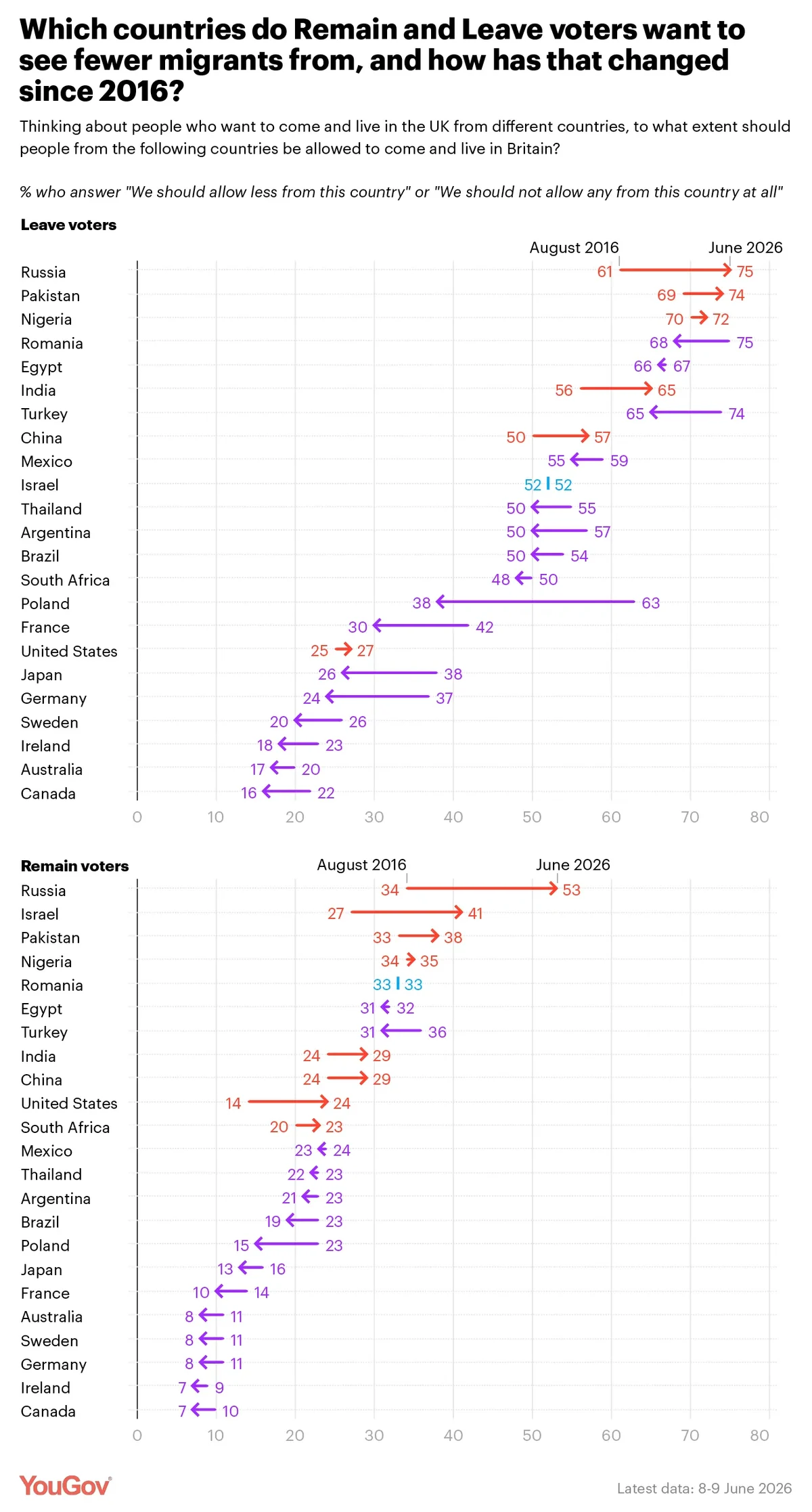
How have Remain and Leave voters’ views changed since 2016 on migrant nationalities?
Notably, the direction of travel in attitudes towards different countries’ migrants is broadly consistent between Remain and Leave voters – there are, for instance, no substantial cases where one voting group has become more welcoming of migrants while the other has become less so.
There are, however, a few instances where opinion among one side has changed while the other voting group has not. This is perhaps most obvious among Remain voters, who are now more likely to want to see fewer or no migrants from the US and Israel, against virtually no change among Leave voters.
Both groups have become significantly more likely to want fewer or no migrants from Russia, while the warming of attitudes towards Poles is present among both groups but particularly pronounced among Leave voters, who are now 25pts less likely to want to see fewer or no migrants from Poland.
Leave voters are also now notably less hostile to migrants from France, Germany and Japan.
Which countries do 2024 voters want to see fewer migrants from?
Again, we see the established trend of Reform UK voters being the most anti-migrant, followed by the Tories, then Labour and the Lib Dems clustered, and finally the Greens.
Some exceptions stand out. Reform UK voters are less likely to want to reduce numbers coming from Russia than the wider trend might have suggested, although 73% nevertheless still want to see fewer or no migrants from Russia.
For their part, Labour, Lib Dem and Green voters are noticeably more likely to want fewer or no migrants from Russia than most other countries we asked about, ranging from 47-57% among these voters.
They are also significantly more likely to want fewer or no migrants from Israel; indeed, among Green voters this is the country they were most likely to want to reduce migrant numbers from, at 51%.
Voters for the trio of left-wing parties are also more likely to want to reduce migration from the US than they are other Western countries, although this only amounts to a quarter (24-25%) in each case.
What do Britons say is important to consider when deciding whether to allow an economic migrant to come to the UK, and how has that changed since 2016?
Britons are far and away most likely to see criminal history as important to deciding whether an economic migrant should be allowed to come to the UK. Fully 94% of Britons say a record of major or violent crimes is an important element to take into account when considering if an economic migrant should be allowed to enter the UK, including 85% who say this is “very important”.
Similarly, 89% consider a criminal record for minor or non-violent crimes is important to consider, with 70% saying this is “very important”.
The next strata of attributes consists of English proficiency, which 86% see as important, and in-demand skills, with almost nine in ten saying that having white and blue collar skills in areas where the UK has skills shortages (87% in both cases) are an important factor to consider. However, a comparatively lower rate of 51-53% consider these three to be “very important” factors.
When it comes to having skills in an area where the UK does not have a shortage, most Britons still say this is an important consideration (64-65%), but this includes only a third who deem it very important (32-33%).
Approximately three quarters of Britons also see a migrant’s level of education (76%) as important, as well as whether they have a job lined up (76%) and whether they intend to bring family with them (73%). These likewise are seen as “very” important by around a third of Britons (33-38%).
Most Britons also see existing wealth (60%), age (56%) and IQ (54%) as important factors, although only 19-23% consider them very important. Religion is the only aspect we asked about that fewer than half of the public see as important (34%), with just 17% seeing it as very important.
When it comes to changes since 2016, there has been a slight increase in the importance attributed to skills. Britons are now 10 percentage points more likely to see white collar skills and eight points more likely to see blue collar skills as important for areas where the UK *does not* have a skills shortage. They are also now seven points more likely to see white collar skills in areas where the UK *does* have a skills shortage as important, compared to a within-the-margin-of-error three point increase for blue collar skills.
Aside from skills, there has been a seven point increase in the numbers seeing a minor criminal record as important, and a five point decrease in the number seeing a migrant’s education level as important.
How do Remain and Leave voters’ views differ on the importance of migrant attributes?
Remain and Leave voters do not differ greatly on many of these attributes, with the largest differences being on the aspects that are seen as least important by the wider public, namely religion, existing wealth, IQ and age, with Leave voters more likely to see all as important than Remain voters.
The trend since 2016 is also similar, with growing perceptions among both groups that minor criminal records and skills are important considerations.
In only one area has either side become notably less inclined to see an attribute as important, with Remain voters somewhat less likely to think education is an important factor, falling from 82% to 74%.
How do 2024 voters differ on what factors are important to consider when deciding whether to let an economic migrant come to the UK?
Predictably, Reform and Tory voters are the most likely to see each factor as important, and Green voters the least. However, the extent to which there is consensus between voting groups differs greatly.
For example, practically the same number of voters in each group see major or violent crimes as important (96-97%), and likewise for skills and English proficiency consensus still remains relatively high.
By contrast, for areas that the public as a whole finds less important, differences become much more pronounced. At its most extreme we see 67% of Reform UK voters saying that a potential migrant’s religion is important to consider, compared to only 12% of Green voters.
Interested in taking YouGov surveys? What do you think about immigration, small boats, and everything else? Have your say, join the YouGov panel, and get paid to share your thoughts. Sign up here.
Interested in commissioning YouGov research? We connect in real-time with real people around the world to gather their thoughts, behaviours, and opinions, to ensure that our research data is powered by reality. Explore our survey services here.
Photo: Getty