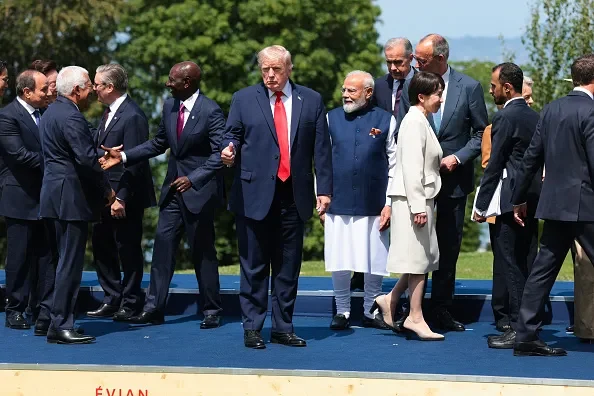
The global power landscape has shifted substantially in recent decades. Much of the latter half of the 20th century saw the US and USSR dominate as dual superpowers, followed by a period of American hegemony. Now the world appears to be moving in a more multipolar direction, not least with the ascension of China, with the EU also emerging as a key global player, and India likely to play a bigger role in world affairs.
So where do people in our seven countries see their own country in terms of their own power, and who do they see as being the key global influencers in 20 years’ time?
How powerful do people see their own countries as being overall?
In terms of their own country, Americans unsurprisingly have the most positive view. Four in ten in the US (41%) brand their country a “superpower”, with a further 29% labelling it a “great power”.
By contrast, in almost all the other countries listed the most common answer is “a medium power”, at between 36-46%.
Within this grouping, the French tend to lean more towards being a great power, at 26%, compared to 18% who see la France as a “smaller power”. By contrast, in Canada as many lean more towards great power (19%) as to smaller power (21%).
In Germany, slightly more deem Deustchland to be a smaller power (20%), than a greater one (14%), while Australians and perhaps surprisingly Britons take a much more negative view, with almost as many believing their countries to be smaller powers (34-36%) as think they are medium powers (36-40%).
By contrast, Poles tend to opt out of the power classification entirely, with 42% saying “none of these”. Those who did give a substantive answer were largely split between the 18% who see Poland as a medium power and the 21% who see it as a smaller power.
In what ways do people see their countries as powerful (or not)?
When it comes to the ways in which countries see themselves as power, we again see the US leading the pack.
Across all four measures, most Americans believe the US has either “a lot” or “a fair amount” of military power (83%), economic power (75%), diplomatic power (62%) and cultural influence (67%).
Across the other countries, the tendency is to feel they have little to no power in each of these four areas, with certain exceptions.
In France, fully 63% feel their country has significant cultural influence, with French people also split when it comes to military power (49%-43%) and diplomatic power (46-44%).
Half of Germans (51%) feel their country is economically powerful, while 51% of Canadians say they are diplomatically powerful.
Who will be the most powerful in 20 years?
Asked to look ahead over four categories – technology, economic power, military power and cultural influence – shows a great deal of anticipation for the continued rise of China.
In every country listed, the most common response is that China will be the most technologically powerful country in 20 years, ranging from 43% to 61%. Americans are the least likely to feel this way, but they still place it above their own country, which scored 31% (with only 12-18% in the other nations expecting the US to hold the top spot technologically).
China is also expected to be the most economically powerful nation, albeit to a more limited degree, with between 34% and 57% saying so. Americans again are the least likely to think so, with an equal 34% saying the USA will be the most powerful economy.
When it comes to military power, opinion is more divided. Americans strongly tend to expect they will remain the number one military power, at 50% compared to 20% for China. In Australia, the opposite is true, with 46% saying China and 30% the US.
Germans, Poles and the French lean somewhat towards the US, while Canadians and Britons are relatively evenly split.
Across these three categories, a mere 1-11% had said they think the EU or India would be the most powerful entity in 20 years, but when it comes to the fourth category – cultural influence – the EU performs somewhat more favourably.
In this case, there is something of a three-way tussle between the EU, US and China in terms of cultural influence two decades from now.
In each country, between 12-16% think China will be the most influential nation, while 12-22% say the US and 16-29% say the EU. In France and Germany, the EU leads by double digits relative to the other options.
American attitudes differ, with 37% thinking the US will be the most culturally powerful country, versus only 9% for the EU and 12% for China.
Results
Topline results for each country
Individual country results
Interested in taking YouGov surveys? What do you think about the United States, global politics, and everything else? Have your say, join the YouGov panel, and get paid to share your thoughts. Sign up here.
Interested in commissioning YouGov research? We connect in real-time with real people around the world to gather their thoughts, behaviours, and opinions, to ensure that our research data is powered by reality. Explore our survey services here.
Photo: Getty