While positivity towards Andy Burnham is still widespread, the Labour party’s image still tends to be negative
Key takeaways
- Support for Labour has increased since Andy Burnham replaced Keir Starmer as leader
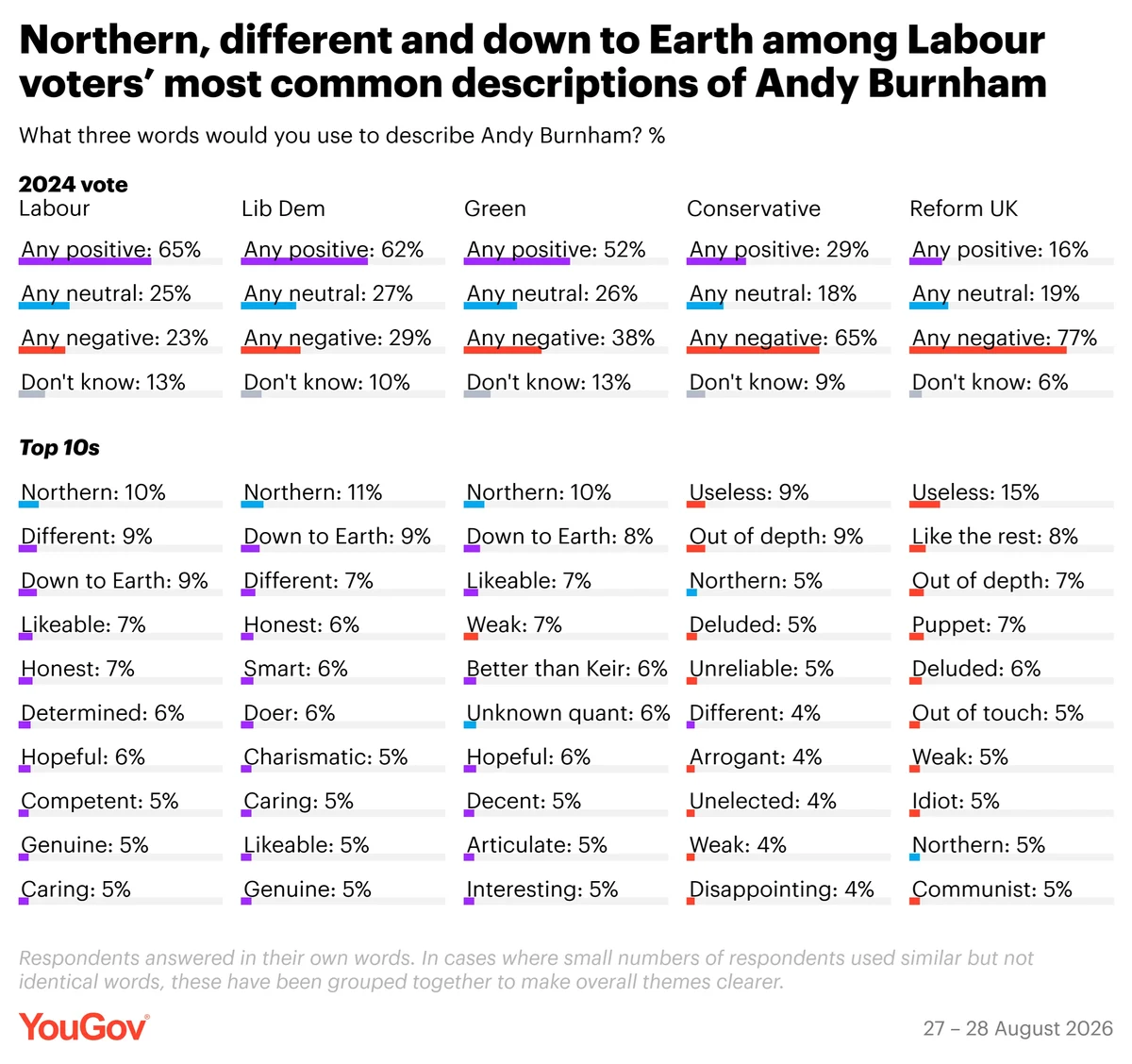
- When Britons are asked to describe Andy Burnham in their own words, 43% give at least one positive word while 42% give one or more negative terms
- “Down to Earth”, “different” and “likeable” are among the most common positive terms to describe Burnham, while “useless”, “out of his depth” and “like the rest” are among the top negative descriptors
- Additionally, 23% give at least one neutral term in their three-word description, including 7% characterising Burnham as “northern”
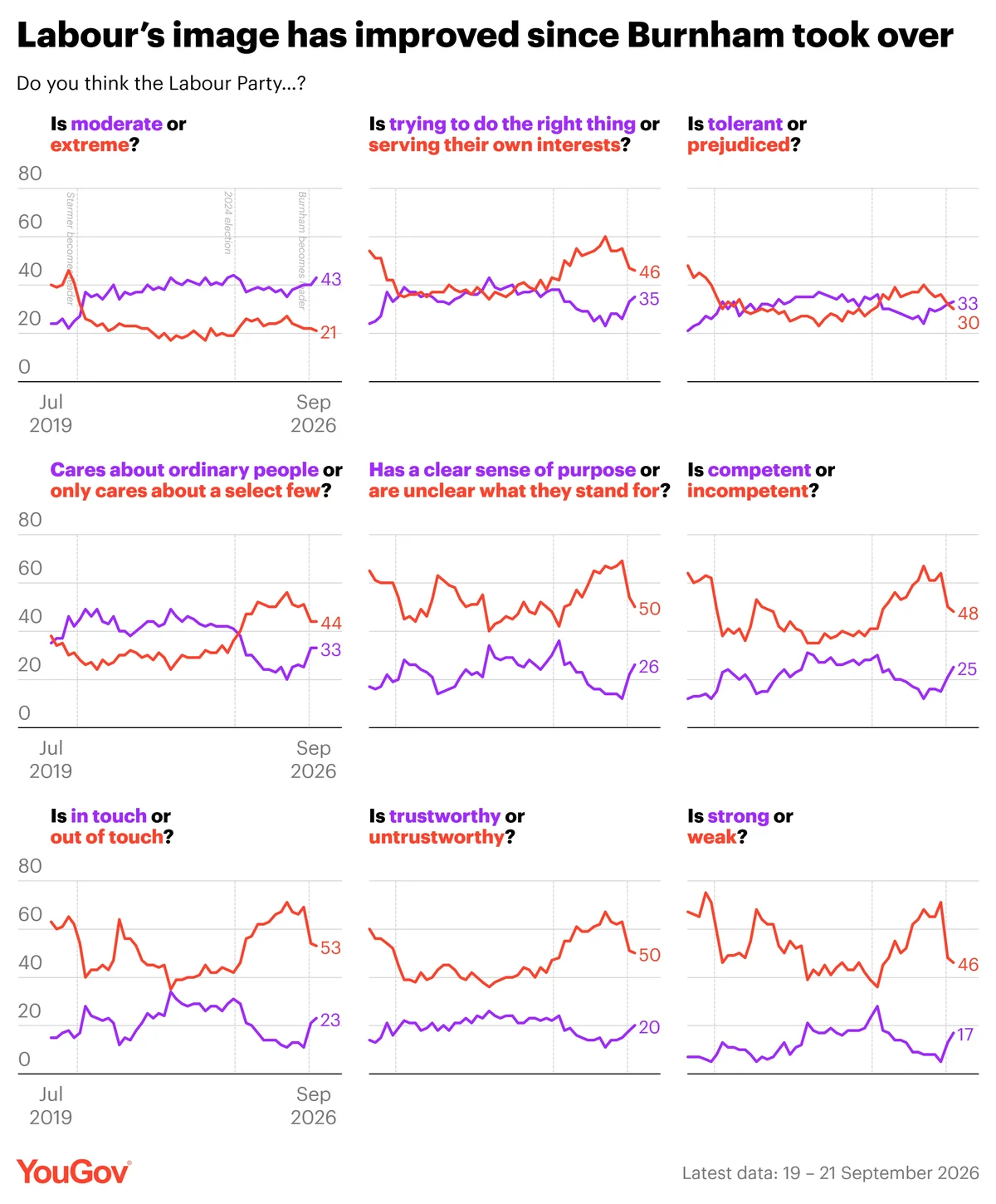
- Attitudes towards Labour have improved in recent months, but a majority of Britons continue to feel Labour are out of touch, while the public still tend to see Labour as untrustworthy, weak, incompetent and unclear in what they stand for
On Sunday, it’s Labour’s turn to kick off their annual party conference, the first since Andy Burnham replaced Keir Starmer as leader. The mood in Liverpool will likely be a bit more upbeat than it was last September, with the ongoing ‘Burnham bounce’ improving the party’s fortunes from the nadir they were stuck in for most of the last year.
Indeed, since May, when Burnham was allowed to return to parliament in the aftermath of Labour suffering severe losses in the devolved and local elections, the party’s support has increased significantly. This month, the proportion of Britons giving Labour as their main voting intention has averaged at 18%, up from 13% in May, while around a third (32%) now say they would consider voting Labour in a future election, up seven points since May and the highest level this metric has reached since September 2024. The number open to tactically voting Labour has also increased in recent months.
Driving these improvements has been a softening of attitudes towards Labour among those otherwise inclined to back the Greens or Lib Dems. Since May, the proportion of 2024 Labour voters saying they intend to back the party again has risen from 39% to 53%, while the share defecting to the Greens or the Lib Dems has fallen from 28% to 18%. By comparison, there has been no significant change in the proportion moving to Reform or the Conservatives between May (11%) and today (10%).
Beyond those who voted Labour into power, the proportion of 2024 Green voters willing to consider Labour has risen from 24% to 39% since May, with an increase from 32% to 42% among 2024 Lib Dems. One in ten 2024 Conservatives (10%) say they would be open to voting Labour today, up from 5% in May, while the proportions among Reform voters remain very small (from 2% to 4%).
However, while this is undoubtedly a recovery, there is no getting away from the fact all these figures are substantially below their equivalent at the time of the 2024 election. The party is yet to post a statistically significant voting intention lead with YouGov this year and, were an election taking placing tomorrow, they would very likely suffer severe losses, with our latest MRP model projecting a hung parliament.
What do Britons think of Andy Burnham?
At the centre of this partial recovery is, of course, Andy Burnham, whose still positive personal ratings set him apart from both his predecessor and his opponents in other parties.
Burnham’s latest net favourability rating of +7 compares to scores of -15 for Kemi Badenoch, -29 for Zack Polanski and -45 for Nigel Farage, and includes ratings of +58 among 2024 Labour voters, +33 among 2024 Lib Dems and +12 among 2024 Greens. Even with those who voted for the Conservatives or Reform last time, among whom Burnham has clearly negative ratings of -37 and -62 respectively, significant minorities of 26% and 15% currently see him in a positive light.
Beyond the popularity aspect, our latest tracker figures show Britons are also more likely to believe Burnham is doing well as prime minister (41%) than badly (36%), though the latter figure has increased by five points over the last month.
How would Britons describe Andy Burnham?
Whether Britons like or dislike Andy Burnham is one thing, but why is it that they like or dislike him? To find out, we asked the public to describe the new prime minister in three words.
More than four in ten Britons (43%) give at least one positive term when describing Burnham, with these tending to paint a picture of someone relatable, optimistic and unlike other politicians. Among the most common specific descriptions are that the new PM is down to Earth (used by 6%), is fresh and different (5%), or is generally likeable (4%), while allusions to Burnham being caring, charismatic, friendly, genuine, honest, hopeful or upbeat are each made by 2-3% of the public.
Some of those depicting Burnham favourably stress his suitability for the job, with his determined, ‘doer’, pragmatic and intelligent natures all cropping up in 2-3% of Britons’ three-word descriptions of the former Manchester mayor. Similar proportions credit him with being a good communicator, being an overall decent person, or being someone who was listening, while 2% simply describe him as being better than Starmer.
However, these Britons are near-matched by 42% using at least one negative term in their summary of the new occupant of Number 10. One common theme in these descriptions is a belief that Burnham is not up to the job, with 6% of Britons describing him as useless, 4% as inexperienced or out of his depth, while deluded and disappointing are each used by 2%.
Other negativity towards Burnham seemingly stems from not everyone buying that he’s that different, with 3% outright stating he’s ‘like the rest’ or ‘just another politician’, 2% feeling he’s another Starmer, and similar proportions using not uncommon descriptions for a politician such as out of touch and liar. Additionally, 3% describe Burnham as weak, while 2% use their three words to complain that he’s unelected.
Perhaps indicating he’s still a fresh face for many, around a quarter of Britons (23%) use at least one neutral term in their rough sketches of the new Labour leader, with the most common being ‘northern’, which features in 7% of descriptions.
The descriptions of both Labour and Lib Dem voters are largely positive, with 62-65% labelling Burnham in a positive way, including frequent uses (5-9% in both groups) of caring, different, down to Earth, genuine, honest and likeable.
Around a quarter in both groups (25-27%) include one or more neutral terms in their three-word description, including 10-11% identifying Burnham as northern, while similar numbers (23-29%) opt for at least a single critical term, though with no individual negative word being used by more than 2%.
Green voters are more mixed in their descriptions. Although 52% use at least one positive word in their rough sketch of Burnham, with that he is better than Keir Starmer being disproportionately common (6%), around four in ten (38%) have at least one barbed term in mind for the new PM, with weak the most prominent (7%).
Substantial majorities of Reform (77%) and Conservative voters (65%) use negative terms in their descriptions, with useless and out of his depth among the most frequent in both groups. Terms cropping up almost uniquely among Reform voters include that he is a puppet or a communist.
What do Britons think about Labour?
While Burnham’s overall public image might be somewhere between being divided and slightly positive, the same is not currently true of the wider Labour party, which still tends to be viewed negatively. Indeed, in our latest party favourability ratings, Labour still holds a negative net score of -25, even if this has improved in recent months.
A majority of Britons (53%) see Labour as out of touch, with around half (48-50%) viewing the party as being untrustworthy, unclear in what they stand for, or incompetent, relative to as few as 20% saying they find Labour to be trustworthy.
By margins of 44-46% to 33-35%, the public also tend to believe that Labour serve their own interests at the expense of trying to do the right thing, and care only about a select few rather than about ordinary people. Nearly half of Britons (46%) describe Labour as weak, compared to only 17% feeling the party is strong, while the public are also roughly as likely to describe Labour as being prejudiced (30%) as being tolerant (33%).
More positively, Britons are around twice as likely to describe Labour as moderate (43%) than extreme (21%).
Nonetheless, even if opinion on most of these questions does tend to be negative, our tracker data shows that it has, in most cases, improved significantly since Burnham became prime minister.
Since May, the proportion of Britons seeing Labour as weak has fallen by a full 25 points, the number feeling it’s unclear what Labour stands for has fallen 19 points, and beliefs Labour are incompetent or out of touch are both down 16 points. A perception that Labour are untrustworthy has fallen 13 points over the last four months, while the proportion thinking the party is serving their own interests is down nine points.
In all these cases, the proportion holding the opposite view has risen by at least five points since May, including a 14 point increase in the number believing Labour has a clear sense of purpose.
Regardless of these clear improvements, there are still significant minorities of 2024 Labour voters who are dissatisfied with certain aspects of the party. This includes roughly a third (32-35%) feeling it’s unclear what Labour stands for or that it’s out of touch, 28% seeing it as weak, and roughly a quarter (24-26%) believing the party they backed two years ago is untrustworthy, incompetent, or only interested in a select few.
Among Lib Dem and Green voters, who do tend to see Labour as trying to do the right thing, some of these concerns are also widespread. Both groups are more likely to view Labour as untrustworthy than trustworthy, out of touch than in touch, unclear in its purpose than clear in what it stands for, and weak than strong.
Methodology
- Sample size: An online survey of 2,079 adults aged 18+ in Great Britain
- Fieldwork: 27 to 28 August 2026
- Commissioned by: YouGov
Click here for more information about how we carry out research
Interested in taking YouGov surveys? What do you think about Andy Burnham, the Labour party, and everything else? Have your say, join the YouGov panel, and get paid to share your thoughts. Sign up here.
Interested in commissioning YouGov research? We connect in real-time with real people around the world to gather their thoughts, behaviours, and opinions, to ensure that our research data is powered by reality. Explore our survey services here.
Photo: Getty