



2026 reaches its halfway point and Romania’s FMCG market is entering a period of recalibration. Growth is losing momentum, volumes are under pressure, and shoppers are adapting their behavior – not stepping away from the market, but becoming more deliberate in how, where and what they buy. This newsletter edition draws on the latest YouGov Shopper Romania panel data to map that landscape in detail: where growth still exists, who is capturing it and how shopping behavior is adapting to an environment defined by persistent inflation and eroding confidence. The picture isn't uniformly bleak – but it does demand a different playbook.
The Macro Picture: Headwinds Intensifying
Let's start with context. Romania's economy has entered a soft patch. Growth has effectively stalled – GDP is projected at -0.1% this year, a marked slowdown from the already modest 0.7% recorded in 2025. Inflation remains persistently high, with official monthly figures still hovering around double digits and continuing to rank as the highest in the EU. In simple terms, Romania's economy is undergoing a significant macroeconomic adjustment, driven by fiscal consolidation, persistently high inflation, tight monetary conditions and political friction. Fiscal consolidation is progressing, but the deficit remains elevated and public debt continues to rise, limiting policy flexibility.
FMCG Growth: A Market Approaching Stagnation
If there's one word that captures the state of Romania's FMCG in-home market in the first half of 2026, it is deceleration. The headline number is +3.4% value growth, a sharp slowdown from the +10.9% recorded in H1 2025. Dig beneath the surface and the picture becomes even more telling: volumes have turned negative, up-trading has all but vanished and whatever growth remains is essentially being carried by inflation. We've moved from a market that was growing because people were buying more, to one that's growing only because things cost more.
The quarterly trajectory within 2026 paints an even more sobering picture. Q1 delivered +6.1% value growth (still supported by residual price effects), but by Q2, growth had slowed to just +4.4%, with volumes declining by -1.3% – the steepest contraction observed in recent quarters. The down-trade effect, at -0.4% in both Q1 and Q2, confirms that shoppers are systematically choosing more affordable options within categories.
Against this backdrop, shopping behavior in H1 2026 reveals something interesting. Consumers didn't stop shopping – frequency remained virtually flat, ticking up just 0.9% year on year. What changed is how much they're spending each time they do. Spend per trip grew by only 2.5%. That might sound like growth, but compared to the double-digit increases we'd grown accustomed to in past years – when inflation was pushing baskets higher almost mechanically – it represents a significant slowdown.
The quarterly rhythm confirms this moderation. The first quarter still showed some momentum, with spend per trip up 3.9%, but by the second quarter that had softened to just 1.2%. The inflationary tailwind that lifted basket values for three consecutive years has largely dissipated. What we're left with is a market where growth must come from somewhere other than price.
Shoppers Are Holding Back
The economic squeeze is visible in sentiment. Romania's consumer confidence weakened further throughout the first half of the year and remained the weakest in the region, dipping to its lowest point around March and April before recovering only partially by June. The persistent gap versus the EU average tells a simple story: Romanian households are cautious, deliberate and increasingly selective about where their money goes.
Romanian consumers are significantly more pessimistic than the European average when it comes to their financial outlook. According to the latest YouGov Behavior Change Study, nearly two-thirds expect their financial situation to worsen over the coming year – a figure that dwarfs the EU average of 46% and has actually ticked up slightly since last autumn. With only 6% anticipating an improvement, that kind of pervasive pessimism doesn't show up only in survey data; it shows up in baskets, in trip frequency, in the brands people reach for and in the channels where they choose to spend. Only 19% of Romanian shoppers believe their purchasing behavior will remain unaffected, compared to 31% across the EU – a gap that underscores how much more exposed Romanian consumers feel to the current economic pressures and how much more cautious they are likely to remain.
Where Growth Survived – and Where It Didn't
Within this slower market, the growth that does exist is unevenly distributed. Food emerged as the only major macro-category genuinely gaining share, contributing nearly 40% of total FMCG growth – up from around 25% last year. Categories like Beverages and Home Care, which had been meaningful contributors to growth in H1 2025, have softened considerably, held back by declining shopping frequency. Personal Care and Pet Food/Care continued to grow at a moderate pace, but neither is moving the needle in the way Food now is.
Across all segments, whatever growth materialized was driven almost entirely by higher spend per trip – not by shoppers buying more often. Frequency was flat at best and negative in several sectors.
The Great Reallocation: Who's Winning the Value Battle
Perhaps the most strategically significant story of H1 2026 is the rebalancing happening within price segments. Shoppers aren't simply trading down – they're trading across, gravitating toward a middle ground.
Mainstream Brands have emerged as the primary beneficiary of this reallocation and the undisputed engine of growth, gaining 1.2 percentage points of share and contributing a remarkable 60% of total market value growth. Meanwhile, Premium Private Labels, though small in absolute terms, tell an even more compelling growth story: +24.4% value growth and a contribution now exceeding 35% of all market growth.
The losers in this equation are equally clear. Premium Brands have seen their share erode and now contribute just 7% of market growth – a significant fall from relevance in a market that, not long ago, still showed appetite for premiumization. Economy Brands and Budget Private Labels are also losing ground, which tells us something important: this isn't a simple down-trading story. Shoppers aren't just seeking the cheapest option – they're seeking the smartest option.
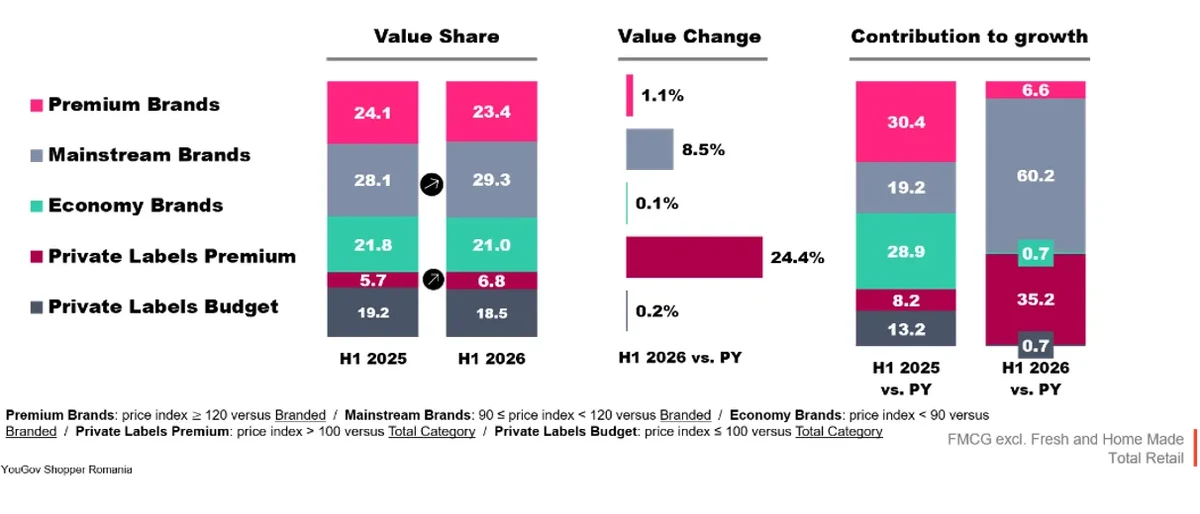
The net switching results paint a vivid picture of this migration. Value is flowing decisively away from the extremes – both premium and budget – and concentrating in that middle territory where Mainstream Brands and Premium Private Labels live. It's a shift that speaks to a shopper who is financially constrained but not willing to compromise entirely on quality.
Across categories, the pattern plays out consistently. Premium Private Labels expanded most notably in Food and Dairy, while Mainstream Brands gained share in Beverages, Personal Care and Home Care.
Promotions Return to the Spotlight
After a brief moderation, promotional intensity is back. Promo value share jumped to 26.5% in H1 2026, up 2.5 percentage points versus last year. Shoppers are increasingly shopping with purpose, targeting specific deals rather than filling large-baskets – consistent with the rise of Cherry-Picking missions we'll come to shortly.
Channels: A Story of Concentration
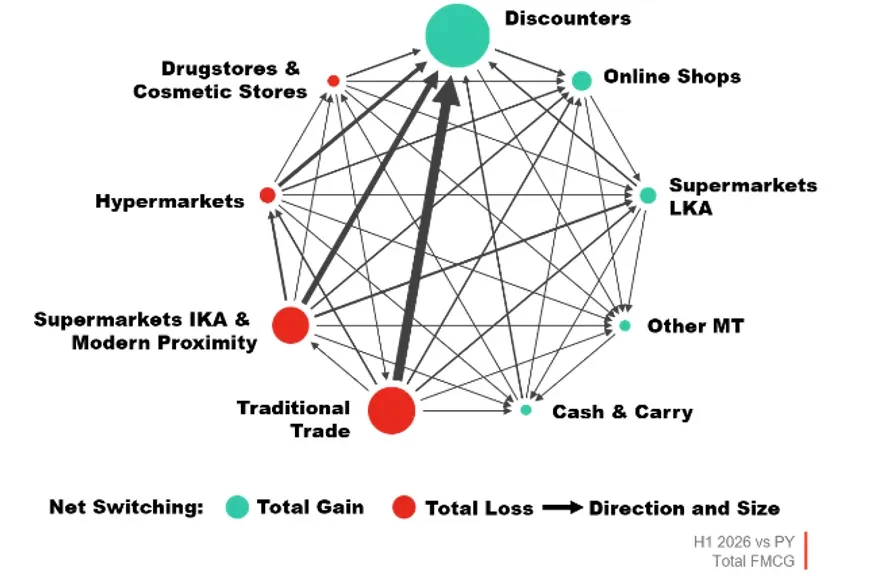
If you've been watching Romania's channel landscape over the past several years, the direction won't surprise you – but the scale might. Discounters remain the key channel shaping the growth in Romania and now command 30.8% of all in-home FMCG value, having grown +8.9% year-on-year while most other channels either stagnated or declined in share. Their growth is broad-based – penetration is rising, frequency is rising and this pattern holds across all community sizes, from Bucharest to rural Romania. They are the clear net winner in shopper switching, pulling value from all brick-and-mortar channels. The most prominent corridor of value transfer remains the one running directly from Traditional Trade into Discounters – though International Supermarkets are also feeding into the Discounters growth.
By contrast, Traditional Trade, once the backbone of Romanian grocery retail, continues its structural retreat, losing 1.3 percentage points of share and now sitting at 21.3%. Hypermarkets held at 24.4%, while Local Supermarkets (LKA) are a quiet bright spot, growing +7.2% and expanding their penetration meaningfully.
Online deserves a mention not for its absolute size – still just 2% of the market – but for its trajectory. At +27.1% growth, it's expanding across reach, frequency and basket size, driven entirely by Online Shops rather than Delivery Apps (which actually declined slightly). It remains a channel to watch, even if its near-term impact on most portfolios is still limited.
At the retailer level, Penny has been the standout performer of this half of the year, combining the strongest gains in both shopper penetration and loyalty – a powerful double win. Lidl, Supeco and LaDoiPași also broadened their shopper bases. DM presents an unusual case: the strongest penetration growth of any retailer, yet accompanied by a significant drop in loyalty.
How People Are Shopping: Smaller, More Targeted, More Deliberate
The way Romanians construct their shopping trips is shifting in ways that reflect the broader mood. Stock-Up and Large Stock-Up missions – those big, planned trips where shoppers fill their pantries for the week – are losing ground. In their place, Cherry-Picking missions (small, promotion-driven baskets of just one to three categories) and One-Need Baskets are gaining share. Shoppers are becoming more surgical: they go in for what they need, grab deals where they find them and resist the pull of the fuller trolley.
This pattern is visible across most channels. Cherry-Picking increased notably in Hypermarkets, Discounters and Online, while One-Need Baskets grew in Discounters and Traditional Trade. The implication is clear – winning isn't just about being on shelf; it's about being visible and compelling in the moment a shopper is making a quick, targeted decision. The days of relying on large-basket inertia are fading.
So What Does All This Mean Going Forward?
We won't sugarcoat it: the near-term remains difficult. There is no catalyst on the horizon that would significantly reverse consumer caution before year-end. Purchasing power is still contracting, fiscal consolidation is likely to weigh on public sentiment and the psychological scars of persistent inflation take time to heal even after the numbers moderate. What's emerging is a more discerning consumer – one who shops with the same frequency but spends more deliberately, who favors channels that deliver value efficiently and who is migrating away from both the most expensive and the cheapest options toward a middle ground that feels right.
In the meantime, the strategic imperatives are clear. For brands: relevance in the mainstream space is essential, premium positioning requires sharper justification, a clear Discounter strategy is no longer optional (it's where nearly a third of the market now lives) and agility on smaller shopping occasions is increasingly important. For retailers: the lesson is about conversion; expanding stores and reaching new shoppers is only half the equation, while the other half is earning their loyalty, trip after trip.
We hope these insights prove useful as you plan for the second half. As always, we're here if you'd like to explore any dimension of this data that matters most to your business, whether that's a category-specific deep dive, channel strategy insights, or a closer look at how your portfolio is positioned against the price tier shifts reshaping this market.
Methodology
YouGov Shopper Panel is based on continuously collected data and rolling surveys on 6,000 households representative for the total population in Romania.
YouGov Shopper Intelligence, Consumer Panel Services [formerly part of the GfK group through 2023], offers access to a wealth of expertise and quality consumer panel data. We help the world’s most recognized FMCG & Retail brands to deliver superior customer experiences at every stage of the shopper journey.